With reference to the role of biofilters in Recirculating Aquaculture System, consider the following statements: 1. Biofilters provide waste treatment by removing uneaten fish feed. 2. Biofilters convert ammonia present in fish waste to nitrate. 3. Biofilters increase phosphorus as nutrient for fish in water. How many of the statements given above are correct?
Contents17
- AOnly one
- BOnly two
- CAll three
- DNone
Show answer
Answer: (B) Only two
Statement 1 is correct:
Biofilters in aquaculture use microorganisms attached to a medium to break down harmful waste and purify water.
Statement 2 is correct:
Nitrifying bacteria in biofilters convert toxic ammonia → nitrite → nitrate, making water safe for fish.
Statement 3 is wrong:
Biofilters help REMOVE phosphorus waste — they do NOT increase phosphorus.
Only two are correct.
Answer is (b).
Recirculating Aquaculture Systems are becoming crucial for sustainable fish farming as they use 99% less water than traditional methods while maintaining high production levels.
The question tests understanding of nitrogen cycle in aquaculture - ammonia from fish waste is toxic, but biofilters convert it through nitrifying bacteria to safer nitrate forms.
Statement 3 is the trap - biofilters actually remove excess phosphorus to prevent algal blooms, they don't add it as a nutrient.
Recirculating Aquaculture Systems (RAS)
Science And Technology Recirculating Aquaculture System RAS
Recirculating Aquaculture Systems: Technology & Components
RAS recirculates water through treatment systems instead of replacing it
Uses biofilters for biological waste treatment and water purification
Enables intensive fish farming with minimal water usage
Controls water quality through mechanical and biological filtration
What is RAS
Recirculating Aquaculture Systems are closed-loop fish farming technologies that continuously filter and reuse water instead of discharging it. They enable intensive fish production with 90-99% less water than traditional aquaculture.
RAS Components
# Recirculating Aquaculture System
## Fish Tanks
- Growing chambers
- Controlled environment
- High density stocking
## Biofilters
- Nitrifying bacteria
- Ammonia conversion
- Biological treatment
## Mechanical Filters
- Remove solid waste
- Uneaten feed removal
- Physical filtration
## Support Systems
- Water pumps
- Aeration
- Temperature control
- UV sterilization
RAS Setup
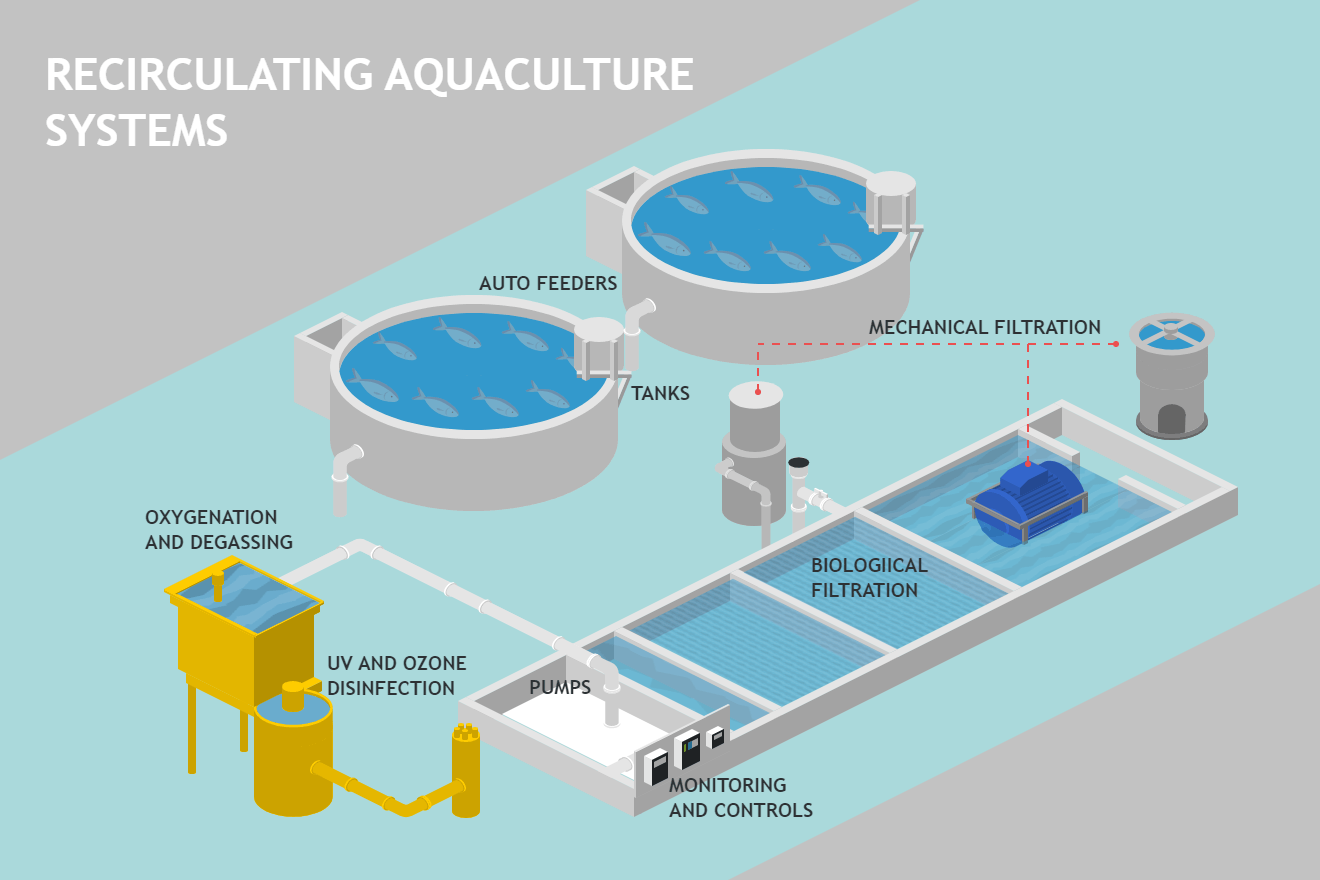
Source: Icograms Designer — Recirculating Aquaculture Systems - Icograms Template · icograms.com
Biofilters in Aquaculture
Science And Technology biofilters waste treatment
Biofilters: Biological Water Treatment in Aquaculture
Biofilters use beneficial bacteria to convert toxic fish waste into harmless compounds
Remove both solid waste (uneaten feed) and dissolved waste (ammonia)
Remove phosphorus from water - do NOT increase it
How Biofilters Work
Biofilters contain beneficial microorganisms attached to a growth medium (plastic media, ceramic rings, or bio-balls). These bacteria colonies break down organic waste and convert toxic compounds into safer forms.
Biofilter Functions
Function | Process | Result | Bacteria Type |
|---|---|---|---|
Mechanical filtration | Remove solid particles | Cleaner water | Mixed microorganisms |
Ammonia conversion | NH₃ → NO₂⁻ → NO₃⁻ | Less toxic water | Nitrifying bacteria |
Organic breakdown | Decompose uneaten feed | Reduced BOD | Heterotrophic bacteria |
Phosphorus removal | Bacterial uptake | Lower nutrient load | Phosphorus-accumulating bacteria |
Question Connection
This PYQ tested whether students understand biofilters remove waste (including phosphorus) rather than adding nutrients. The trap was Statement 3, which incorrectly suggested biofilters increase phosphorus.
Trap: Biofilters increase phosphorus as nutrient - Wrong. They REMOVE phosphorus waste
Confusion: Mixing up waste removal vs nutrient addition functions
Key distinction: Biofilters clean water by removing harmful compounds, not by adding beneficial ones
Nitrogen Cycle in Aquaculture
Science And Technology ammonia nitrate convert
Nitrogen Cycle: Ammonia to Nitrate Conversion in Biofilters
Fish produce ammonia (NH₃) as toxic waste through gills and urine
Nitrifying bacteria convert ammonia → nitrite → nitrate in two steps
Nitrate is much less toxic than ammonia - safe for fish at low concentrations
Why This Matters
Ammonia is highly toxic to fish even at low concentrations. The nitrogen cycle in biofilters converts this deadly waste into nitrate, which fish can tolerate in much higher amounts.
Nitrification Process
%%{init: {"flowchart": {"wrappingWidth": 460}}}%%
flowchart TD
  s1["`**Fish Waste Production**
Fish excrete **ammonia (NH₃)** - highly toxic compound`"]
  s2["`**First Conversion**
**Nitrosomonas bacteria** convert NH₃ → **nitrite (NO₂⁻)**`"]
  s3["`**Second Conversion**
**Nitrobacter bacteria** convert NO₂⁻ → **nitrate (NO₃⁻)**`"]
  s4["`**Safe End Product**
**Nitrate** accumulates but is much less toxic to fish`"]
  s1 --> s2
  s2 --> s3
  s3 --> s4
Nitrogen Compound Toxicity
Compound | Chemical Formula | Toxicity Level | Safe Concentration | Source |
|---|---|---|---|---|
Ammonia | NH₃ | Very High | < 0.02 ppm | Fish waste |
Nitrite | NO₂⁻ | Moderate | < 0.1 ppm | Ammonia conversion |
Nitrate | NO₃⁻ | Low | < 40 ppm | Nitrite conversion |
Key fact: Biofilters convert ammonia TO nitrate - this is the correct direction
Don't reverse: Not nitrate to ammonia - that would make water MORE toxic
Remember: The process makes water SAFER, not more dangerous
Waste Management in Aquaculture
Science And Technology waste treatment uneaten fish feed phosphorus
Aquaculture Waste: Sources, Problems & Treatment Methods
Main waste sources: uneaten feed, fish excreta, and metabolic byproducts
Uneaten feed creates both solid waste and dissolved nutrients
Phosphorus removal is critical - excess phosphorus causes eutrophication
Waste Sources
Intensive aquaculture generates multiple waste streams that must be managed to maintain water quality and prevent environmental pollution.
Types of Aquaculture Waste
Waste Type | Source | Environmental Impact | Treatment Method |
|---|---|---|---|
Solid waste | Uneaten feed, feces | Oxygen depletion, sludge | Mechanical filtration |
Ammonia | Fish metabolism | Fish toxicity, death | Biological filtration |
Phosphorus | Feed, fish excreta | Eutrophication | Biofilter removal |
Organic matter | Decomposing feed | High BOD, poor water quality | Bacterial breakdown |
Feed Waste Problem
Uneaten fish feed is a major waste source in aquaculture. Studies show 20-30% of feed may go uneaten, creating both immediate water pollution and long-term nutrient accumulation.
Waste Treatment Approach
# Aquaculture Waste Management
## Prevention
- Precise feeding
- High-quality feed
- Feeding schedules
## Physical Removal
- Mechanical filters
- Settling tanks
- Screen filters
## Biological Treatment
- Biofilters
- Bacterial breakdown
- Nitrification
## Nutrient Control
- Phosphorus removal
- Nitrogen cycling
- pH management