In the context of WHO Air Quality Guidelines, consider the following statements: 1. The 24-hour mean of PM 2.5 should not exceed 15 µg/m3 and annual mean of PM2.5 should not exceed 5 µg/m3. 2. In a year, the highest levels of ozone pollution occur during the periods of inclement weather. 3. PM10 can penetrate the lung barrier and enter the bloodstream. 4. Excessive ozone in the air can trigger asthma. Which of the statements given above are correct?
Contents15
- A1, 3 and 4
- B1 and 4 only
- C2, 3 and 4
- D1 and 2 only
Show answer
Answer: (B) 1 and 4 only
The answer is (B) Statements 1 and 4 only.
Statement 1 is CORRECT: WHO 2021 guidelines say:
- PM2.5 annual average: should not exceed 5 µg/m³
- PM2.5 24-hour average: should not exceed 15 µg/m³
(These are much stricter than India's current standards!)
Statement 2 is WRONG: Ozone pollution is HIGHEST during SUNNY weather, not bad weather. Ozone forms through chemical reactions that need SUNLIGHT (photochemical reactions). "Inclement weather" means bad/rainy weather — ozone is actually lower then.
Statement 3 is WRONG: PM10 particles can go deep into the lungs, but it's PM2.5 (the smaller particles) that can cross the lung barrier and enter the bloodstream. PM10 is too big to enter the blood.
Statement 4 is CORRECT: Excess ground-level ozone irritates the respiratory system, triggers asthma attacks, reduces lung function, and can cause lung diseases.
WHO released updated Air Quality Guidelines in 2021 with much stricter PM2.5 limits than previous standards, making this a current topic for testing knowledge of pollution standards.
UPSC is testing whether students understand the difference between PM2.5 and PM10 particles - only PM2.5 is small enough to cross from lungs into bloodstream, while PM10 stays in respiratory system.
The ozone statement tests understanding of photochemical pollution - ozone forms during sunny weather through sunlight-driven reactions, not during rainy or cloudy periods.
WHO Air Quality Guidelines 2021
Environment WHO Air Quality Guidelines PM 2.5 15 µg/m3 5 µg/m3
WHO Air Quality Guidelines 2021: PM2.5 & PM10 Standards
WHO 2021: PM2.5 annual mean ≤ 5 µg/m³, 24-hour mean ≤ 15 µg/m³
WHO 2021: PM10 annual mean ≤ 15 µg/m³, 24-hour mean ≤ 45 µg/m³
These are much stricter than India's current NAAQS standards
Guidelines updated in 2021 after 16 years (previous: 2005)
The World Health Organization updated its Air Quality Guidelines in 2021 with much stricter limits for particulate matter. These are health-based recommendations, not legally binding standards that countries must follow.
WHO vs India Standards
Pollutant | WHO 2021 Annual | WHO 2021 24-hour | India NAAQS Annual | India NAAQS 24-hour |
|---|---|---|---|---|
PM2.5 | 5 µg/m³ | 15 µg/m³ | 40 µg/m³ | 60 µg/m³ |
PM10 | 15 µg/m³ | 45 µg/m³ | 60 µg/m³ | 100 µg/m³ |
NO₂ | 10 µg/m³ | 25 µg/m³ | 40 µg/m³ | 80 µg/m³ |
SO₂ | - | 40 µg/m³ | 50 µg/m³ | 80 µg/m³ |
Key Features
Guidelines are recommendations, not binding laws — countries set their own standards
Based on latest health evidence showing harm at lower pollution levels
WHO estimates 7 million premature deaths annually from air pollution
Focus shifted to PM2.5 as primary indicator due to health impacts
Trap: Don't confuse WHO guidelines with India's NAAQS — WHO limits are much stricter
Trap: Statement 1 is correct — WHO 2021 says PM2.5 annual ≤ 5 µg/m³, 24-hour ≤ 15 µg/m³
Trap: Remember 5 and 15 for PM2.5, 15 and 45 for PM10 in WHO 2021
Ground-level Ozone Pollution
Environment ozone pollution inclement weather
Ground-level Ozone: Formation, Weather & Health Effects
Ozone peaks during sunny, hot weather — NOT during inclement weather
Forms through photochemical reactions requiring sunlight + heat
Secondary pollutant — not directly emitted, forms from NOx + VOCs
Triggers asthma attacks and respiratory problems
Ground-level ozone is a harmful secondary pollutant that forms when sunlight triggers chemical reactions between nitrogen oxides (NOx) and volatile organic compounds (VOCs). Unlike protective ozone in the stratosphere, tropospheric ozone is a major health hazard.
Ozone Formation Process
%%{init: {"flowchart": {"wrappingWidth": 460}}}%%
flowchart TD
  s1["`**Primary Emissions**
Vehicles & industries emit **NOx** and **VOCs**`"]
  s2["`**Sunlight + Heat**
**UV radiation** and high temperatures (>25°C) act as catalysts`"]
  s3["`**Photochemical Reaction**
NOx + VOCs + Sunlight → **Ground-level Ozone (O₃)**`"]
  s4["`**Peak Formation**
Highest ozone levels in **afternoon** (2-4 PM) on sunny days`"]
  s1 --> s2
  s2 --> s3
  s3 --> s4
Weather Impact on Ozone
Weather Condition | Ozone Level | Reason |
|---|---|---|
Sunny, Hot Days | HIGH | UV light drives photochemical reactions |
Inclement Weather | LOW | Rain washes out precursors, clouds block UV |
Calm, Stagnant Air | HIGH | Pollutants accumulate, no dispersion |
Windy Conditions | LOW | Dispersion of precursor pollutants |
Health Effects
Triggers asthma attacks and worsens existing respiratory conditions
Reduces lung function and causes chest pain, coughing
Long-term exposure linked to premature death from respiratory diseases
Children and elderly are most vulnerable populations
Trap: Statement 2 is WRONG — ozone is highest during sunny weather, not inclement weather
Trap: Don't confuse good ozone (stratosphere) with bad ozone (ground-level)
Trap: Statement 4 is correct — ozone definitely triggers asthma
Trap: Ozone is a secondary pollutant — forms from reactions, not direct emissions
Particulate Matter PM2.5 vs PM10
Environment PM10 PM2.5 lung barrier bloodstream
PM2.5 vs PM10: Size, Penetration & Health Impacts
PM2.5 can cross lung barrier and enter bloodstream — PM10 cannot
PM2.5 ≤ 2.5 micrometers, PM10 ≤ 10 micrometers in diameter
Smaller particles = deeper penetration and greater health harm
Both cause respiratory problems, but PM2.5 also affects cardiovascular system
Particulate Matter is classified by size because smaller particles penetrate deeper into the respiratory system. The number indicates the maximum diameter in micrometers — PM2.5 particles are 4 times smaller than PM10.
PM2.5 vs PM10 Comparison
Aspect | PM2.5 (Fine) | PM10 (Coarse) |
|---|---|---|
Size | ≤ 2.5 micrometers | ≤ 10 micrometers |
Penetration | Crosses lung barrier → bloodstream | Reaches deep lungs only |
Health Impact | Cardiovascular + Respiratory | Primarily respiratory |
Sources | Combustion, vehicular emissions | Dust, construction, pollen |
Visibility | Causes haze, reduces visibility | Less impact on visibility |
Filtration | Hard to filter, needs HEPA | Easier to filter out |
Particle Penetration
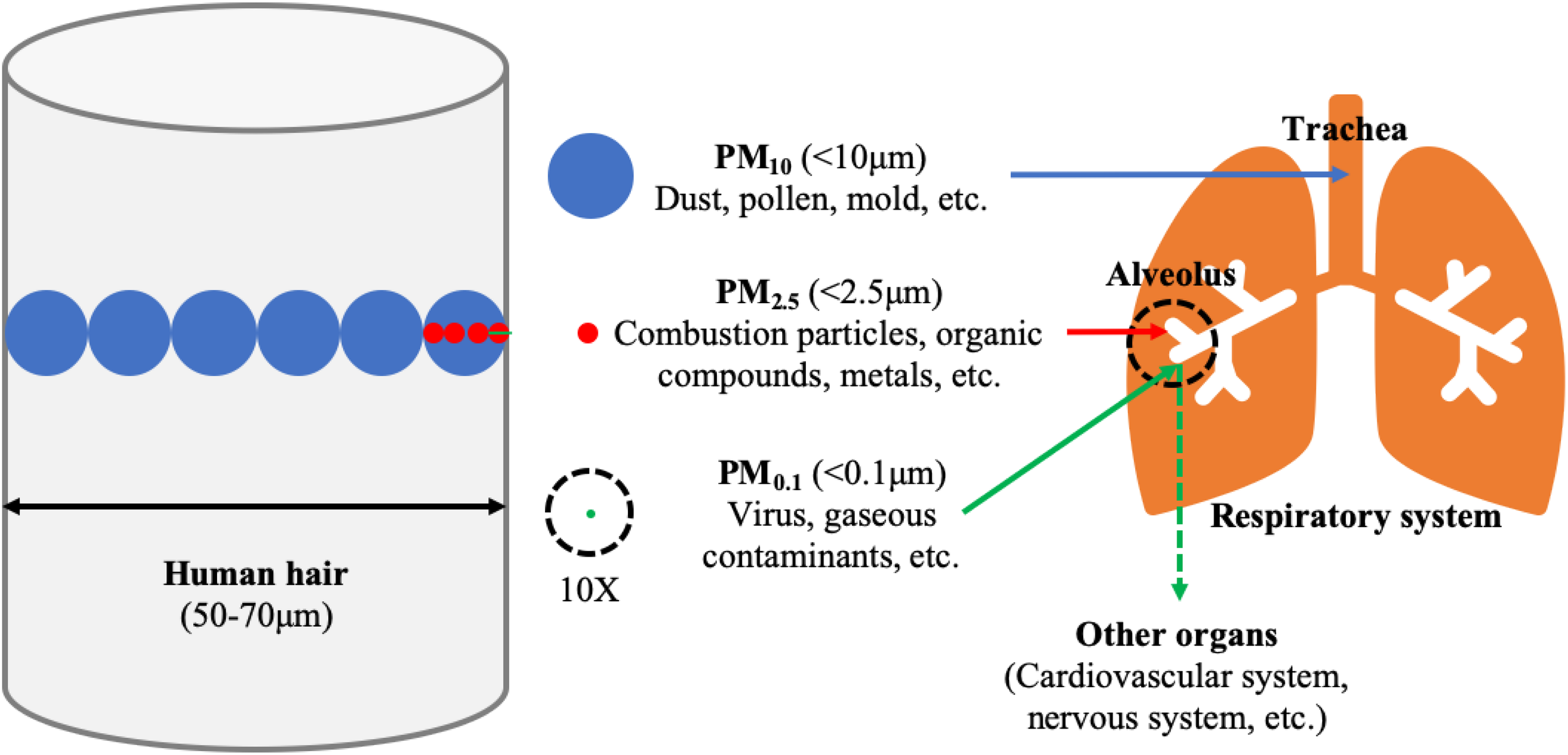
Source: Frontiers — Frontiers | The Impact of PM2.5 on the Host Defense of Respiratory ... · www.frontiersin.org
Health Mechanisms
PM2.5 enters bloodstream → affects heart, brain, other organs beyond lungs
PM10 gets trapped in deep lung tissue → causes inflammation, reduced lung function
Both carry toxic chemicals and heavy metals into the body
Long-term exposure increases risk of lung cancer, heart disease, stroke
Trap: Statement 3 is WRONG — PM2.5 enters bloodstream, NOT PM10
Trap: Remember smaller number = smaller particle = deeper penetration
Trap: Don't assume all particulate matter behaves the same — size determines health impact
Air Pollution Health Effects
Environment asthma trigger asthma
Air Pollution Health Effects: Respiratory & Cardiovascular
Ozone definitely triggers asthma attacks and worsens symptoms
PM2.5 causes both respiratory and cardiovascular diseases
Air pollution causes 7 million premature deaths globally per year (WHO)
Children and elderly are most vulnerable populations
Health Impact Categories
# Air Pollution Health Effects
## Respiratory
- Asthma attacks
- Reduced lung function
- Chronic bronchitis
- Lung cancer
## Cardiovascular
- Heart attacks
- Strokes
- High blood pressure
- Irregular heartbeat
## Other Systems
- Brain inflammation
- Diabetes risk
- Pregnancy complications
- Immune system
## Vulnerable Groups
- Children
- Elderly
- Pregnant women
- Heart/lung patients
Pollutant-Specific Health Effects
Pollutant | Primary Health Effects | Mechanism |
|---|---|---|
Ground-level Ozone | Asthma attacks, chest pain, coughing | Irritates airways, inflammation |
PM2.5 | Heart disease, stroke, lung cancer | Enters bloodstream, systemic effects |
PM10 | Respiratory infections, reduced lung function | Lodges in deep lung tissue |
NO₂ | Increased infection susceptibility | Damages lung lining |
SO₂ | Breathing problems, heart disease | Airway constriction |
WHO Health Evidence
No safe threshold — health effects occur even at low pollution levels
7 million deaths annually worldwide attributed to air pollution exposure
91% of global population lives in areas exceeding WHO guidelines
Economic cost: $2.9 trillion annually in health-related expenses globally
Trap: Statement 4 is definitely correct — ozone triggers asthma, well-established fact
Trap: Don't underestimate air pollution health impacts — they're extensive and proven
Trap: Remember both respiratory AND cardiovascular effects, not just breathing problems