If another global financial crisis happens in the near future, which of the following action/policies are most likely to give some immunity to India? 1. Not depending on short-term foreign borrowings 2. Opening up to more foreign banks 3. Maintaining full capital account convertibility Select the correct answer using the code given below:
Contents21
- A1 only
- B1 and 2 only
- C3 only
- D1, 2 and 3
Show answer
Answer: (A) 1 only
This question asks what would protect India from a future global financial crisis.
The key idea: LESS exposure to foreign financial markets = MORE protection.
Option 1 (Not depending on short-term foreign borrowings) — CORRECT:
Short-term foreign loans mean you have to pay back quickly.
During a crisis, this becomes very difficult and stressful.
So avoiding short-term foreign debt gives protection.
Option 2 (Opening up to more foreign banks) — NOT CORRECT:
This is the opposite of protection!
More foreign banks in India means greater connection to global markets.
If a crisis hits globally, these banks would transmit that shock directly into India's economy.
Option 3 (Adopting full capital account convertibility) — NOT CORRECT:
Full capital account convertibility means anyone can freely move money in and out of India without restrictions.
This sounds nice but is very risky — during a crisis, foreign investors could pull out all their money at once (called "capital flight"), devastating the economy.
This is exactly what happened during the 1997 Asian Financial Crisis when Southeast Asian economies collapsed because foreign money fled suddenly.
Only Option 1 gives immunity.
Answer: A.
Key Takeaway:
During financial crises, ISOLATION from global markets helps.
Less foreign borrowing = more safety.
More foreign bank access or full convertibility = more risk.
Short-term foreign borrowings create immediate repayment pressure during crises, while full capital account convertibility allows rapid capital flight that can destabilize the entire economy.
The 2008 global financial crisis showed that countries with less exposure to foreign financial markets suffered less damage than those deeply integrated into global finance.
UPSC is testing whether students understand that financial integration increases vulnerability rather than providing protection during global crises.
Short-term Foreign Borrowings
Indian Economy short-term foreign borrowings
Short-term Foreign Borrowings: Crisis Vulnerability & India's Approach
Short-term foreign borrowings mature within 1 year and create repayment pressure during crises
Countries with high short-term debt ratios face sudden stops in capital flows during global crises
India maintains relatively low short-term debt as a share of total external debt for stability
Crisis Vulnerability
Short-term foreign borrowings are loans that must be repaid within one year. During financial crises, these create severe stress because countries need foreign currency quickly when global markets are frozen and investors are fleeing.
Debt Maturity Comparison
Type | Maturity | Crisis Risk | Rollover Need |
|---|---|---|---|
Short-term debt | Less than 1 year | Very High | Frequent refinancing required |
Medium-term debt | 1-5 years | Moderate | Manageable refinancing |
Long-term debt | More than 5 years | Low | Stable, predictable payments |
Why Short-term Debt Hurts
Sudden stops: Foreign lenders refuse to roll over maturing loans during crisis
Foreign exchange pressure: Country needs dollars/euros immediately when they're scarce
Contagion effect: Crisis spreads faster through short-term debt channels
Policy constraints: Government forced into austerity to service debt quickly
India's Approach
India deliberately keeps short-term external debt low relative to total external debt and foreign exchange reserves. This debt maturity management provided cushion during the 2008 global financial crisis.
Trap: Don't confuse short-term debt with FDI - FDI is equity investment, not borrowing
Trap: External Commercial Borrowings (ECBs) can be short-term or long-term - maturity matters
Trap: Short-term debt includes trade credits and NRI deposits with quick withdrawal options
Foreign Banks in India
Indian Economy foreign banks
Foreign Banks in India: Integration vs Financial Stability
Foreign banks bring global financial integration but also transmit external shocks
More foreign bank presence increases crisis contagion risk, not immunity
India allows foreign banks through subsidiaries and branches under RBI regulation
Double-edged Integration
Foreign banks bring capital, technology, and global best practices to India. However, they also create direct transmission channels for global financial shocks into the domestic banking system.
Foreign Bank Impact
Aspect | Benefits | Crisis Risks |
|---|---|---|
Capital flows | Bring foreign investment | Can withdraw during global stress |
Technology | Modern banking systems | Complex instruments increase systemic risk |
Competition | Efficient banking services | Aggressive lending in boom, tight in bust |
Regulation | Global compliance standards | Home country rules may conflict with local needs |
Crisis Transmission Channels
Parent bank stress: Foreign banks cut India operations when global parent faces losses
Funding withdrawal: Foreign banks reduce lending when global liquidity dries up
Risk appetite changes: Foreign banks become conservative simultaneously across markets
Regulatory coordination: Home country regulators may force capital repatriation
India's Regulatory Stance
RBI maintains cautious approach to foreign bank entry. Recent policy requires foreign banks with significant business to operate as locally incorporated subsidiaries rather than branches, providing better regulatory control.
Trap: More foreign banks ≠ more immunity - it increases global integration and vulnerability
Trap: Don't confuse foreign banks with FDI in banking - different policy frameworks
Trap: Subsidiary model gives more RBI control than branch banking model
Capital Account Convertibility
Indian Economy capital account convertibility
Capital Account Convertibility: Risks & Benefits for Crisis Management
Full CAC allows unrestricted capital flows in and out of the country
India has partial CAC - current account is fully convertible, capital account has selective controls
Full CAC increases capital flight risk during global crises, not immunity
Tarapore Committee recommended gradual move to full CAC with preconditions
Understanding CAC
Capital Account Convertibility means residents and non-residents can freely convert domestic currency into foreign currency for capital transactions - investments, loans, and asset purchases. This is different from current account convertibility which covers trade and services.
Current vs Capital Account
Account Type | Covers | India's Status | Crisis Impact |
|---|---|---|---|
Current Account | Trade, services, transfers | Fully convertible since 1994 | Limited impact - trade adjusts gradually |
Capital Account | Investments, loans, assets | Partially convertible | High volatility - hot money flows |
Combined (Full CAC) | All transactions | Not adopted | Maximum volatility and flight risk |
Full CAC Crisis Risks
Capital flight: Foreign investors can instantly withdraw all investments during panic
Currency collapse: Massive outflows cause sharp rupee depreciation
Reserve depletion: Central bank forced to use forex reserves to defend currency
Contagion amplification: Crisis spreads faster through unrestricted capital channels
Policy helplessness: Government cannot impose emergency capital controls quickly
Asian Crisis Lesson
The 1997 Asian Financial Crisis demonstrated full CAC dangers. Countries like Thailand and South Korea with open capital accounts faced devastating sudden stops and currency collapses when foreign capital fled simultaneously.
1997 Crisis Impact
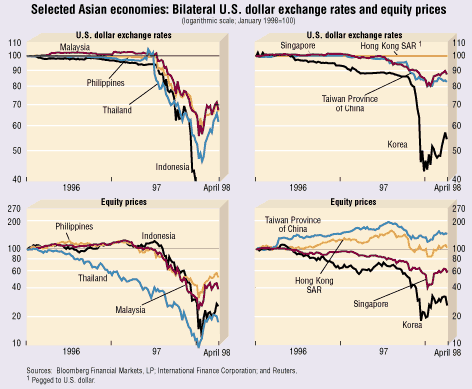
Source: International Monetary Fund — Finance & Development June 1998 -The Asian Crisis: Causes and Cures · www.imf.org
Trap: Full CAC ≠ crisis immunity - it increases vulnerability through capital flight
Trap: India's current account is fully convertible but capital account remains restricted
Trap: Hot money (short-term portfolio flows) is most dangerous under full CAC
Trap: Tarapore Committee recommended CAC but with strict preconditions India hasn't met
Financial Crisis Immunity Strategies
Indian Economy global financial crisis immunity
Building Financial Crisis Immunity: India's Policy Framework
Crisis immunity requires reduced external vulnerabilities and policy buffers
Less global integration paradoxically provides more protection during external crises
India's gradual liberalization approach helped during 2008 global financial crisis
Crisis Immunity Logic
Financial crisis immunity means an economy can withstand external shocks without major domestic disruption. The key insight: selective isolation from risky global financial flows provides more protection than full integration.
Policy Tools for Crisis Immunity
Policy Tool | Mechanism | Crisis Protection | Trade-off |
|---|---|---|---|
Forex reserves | Buffer against external pressure | High protection | Opportunity cost of holding reserves |
Capital controls | Limit volatile capital flows | High protection | Reduced foreign investment access |
Banking regulation | Limit risky exposures | High protection | Lower banking profitability |
Fiscal buffers | Counter-cyclical policy space | Medium protection | Lower government spending in normal times |
Diversified exports | Reduce trade concentration risk | Medium protection | Slower specialization benefits |
India's Crisis Defense Architecture
# Financial Stability Framework
## External Buffers
- Large forex reserves
- Current account management
- Debt maturity control
## Capital Controls
- FPI investment limits
- ECB regulations
- Participatory notes restrictions
## Banking Safeguards
- Conservative provisioning
- Foreign bank subsidiary model
- Priority sector lending
## Policy Space
- Monetary policy independence
- Fiscal counter-cyclical capacity
- Regulatory flexibility
2008 Crisis Lessons
India's resilience: Relatively insulated banking sector and limited toxic asset exposure
Gradual liberalization benefit: Avoided excessive leverage and complex financial instruments
Policy response capacity: RBI could cut rates aggressively, government could increase spending
External buffer utility: Forex reserves provided confidence and import cover
Trap: More financial openness ≠ more crisis immunity - often the opposite is true
Trap: Crisis immunity comes from policy buffers, not market efficiency alone
Trap: Integration benefits (growth, efficiency) vs stability costs (crisis vulnerability) trade-off