Which of the following is/are the possible consequence/s of heavy sand mining in river beds? 1. Decreased salinity in the river 2. Pollution of groundwater 3. Lowering of the water-table Select the correct answer using the code given below:
Contents18
- A1 only
- B2 and 3 only
- C1 and 3 only
- D1, 2 and 3
Show answer
Answer: (B) 2 and 3 only
Correct Answer: (b) 2 and 3 only
Decreased salinity in the river — WRONG: Heavy sand mining actually INCREASES salinity, not decreases it. When sand is removed from riverbeds, the river becomes deeper. This allows saltwater from the sea to intrude further inland (especially in coastal rivers), increasing salinity. Think of it this way: sand acts as a natural barrier — remove it, and saltwater creeps in.
Pollution of groundwater — CORRECT: Sand mining deepens the riverbed, which lowers the water table. This can expose groundwater to pollutants and contamination. Also, the removal of sand (which acts as a natural filter) reduces the filtration of water seeping into the ground.
Deepening of the river bed — CORRECT: This is the most direct and obvious effect. When you remove sand from a riverbed, the bed gets deeper. This deepening can lead to bank erosion (riverbanks collapse), bridge foundations getting exposed, and damage to nearby infrastructure.
REMEMBER: Sand mining effects: river gets DEEPER (bed deepens) → banks erode → saltwater intrudes (salinity INCREASES, not decreases) → groundwater gets polluted. The trick in this question is Statement 1 — salinity increases, not decreases.
Sand mining has caused major environmental damage across Indian rivers like the Yamuna, Krishna, and Cauvery, leading to bridge collapses and groundwater contamination.
The tricky part is salinity - removing sand allows saltwater to intrude further inland in coastal rivers, so salinity increases rather than decreases.
UPSC is testing whether students understand the chain reaction: sand removal → deeper riverbed → saltwater intrusion → increased salinity, not decreased.
Sand Mining Environmental Impacts
Environment heavy sand mining river beds
Sand Mining in Rivers: Environmental Consequences & UPSC Traps
Sand mining deepens riverbeds causing structural and ecological damage
Increases salinity (not decreases) due to saltwater intrusion
Pollutes groundwater by removing natural sand filters
Lowers water table and destabilizes riverbanks
Sand mining involves extracting sand from riverbeds for construction purposes. When sand is removed, it creates a cascade of hydrological changes that affect both surface water and groundwater systems.
Direct vs Indirect Impacts
Impact Type | Mechanism | Consequences |
|---|---|---|
Riverbed Deepening | Physical removal of sand | Bank erosion, bridge foundation exposure |
Saltwater Intrusion | Deeper channel allows sea water penetration | Increased salinity in coastal rivers |
Groundwater Pollution | Loss of sand filtration + lowered water table | Contamination of aquifers |
Water Table Lowering | Deeper riverbed drains surrounding areas | Wells dry up, vegetation stress |
Sand Mining Impact Chain
%%{init: {"flowchart": {"wrappingWidth": 460}}}%%
flowchart TD
  s1["`**Sand Extraction**
Heavy machinery removes sand from riverbed`"]
  s2["`**Riverbed Deepening**
Channel becomes deeper and wider`"]
  s3["`**Hydrological Changes**
Water flow patterns alter, banks destabilize`"]
  s4["`**Saltwater Intrusion**
Deeper channel allows seawater to penetrate inland`"]
  s5["`**Groundwater Impact**
Water table drops, natural filtration reduced`"]
  s1 --> s2
  s2 --> s3
  s3 --> s4
  s4 --> s5
Sand Mining Visual Impact

Source: ScienceDirect.com — Sand mining in the Mekong Delta: Extent and compounded impacts ... · www.sciencedirect.com
Question Analysis
This question tests understanding of cause-and-effect relationships in environmental degradation. Statement 2 (groundwater pollution) and Statement 3 (water table lowering) are direct consequences. The trap is Statement 1 — sand mining increases salinity, not decreases it.
Trap: Salinity increases due to sand mining, not decreases — deeper channels allow saltwater intrusion
Confusion: Students think removing sand = removing salt, but sand acts as a barrier against seawater
Memory aid: Sand mining = Deeper river = More saltwater intrusion = Higher salinity
Statement reversal: UPSC often tests opposite effects — always check if the impact direction is correct
Saltwater Intrusion in Rivers
Environment salinity river
Saltwater Intrusion: Causes, Mechanism & Environmental Impact
Salt wedge moves upstream when river flow decreases or channel deepens
Tidal influence pushes seawater into rivers during high tide
Human activities like dredging and sand mining worsen intrusion
Saltwater intrusion occurs when seawater moves upstream into freshwater rivers, especially in coastal and estuarine areas. This process is controlled by the balance between river flow (pushing seawater out) and tidal forces (pushing seawater in).
Factors Affecting Saltwater Intrusion
Factor | Effect on Intrusion | Example/Impact |
|---|---|---|
Reduced River Flow | Increases intrusion | Drought, upstream dams reduce freshwater push |
Channel Deepening | Increases intrusion | Sand mining, dredging create deeper pathways |
High Tides | Increases intrusion | Spring tides push saltwater further inland |
Sea Level Rise | Increases intrusion | Climate change raises baseline saltwater level |
Salt Wedge Formation
%%{init: {"flowchart": {"wrappingWidth": 460}}}%%
flowchart TD
  s1["`**Density Difference**
Saltwater (heavier) flows beneath freshwater (lighter)`"]
  s2["`**Wedge Formation**
Creates triangular saltwater wedge moving upstream`"]
  s3["`**Tidal Pumping**
High tide pushes wedge further inland`"]
  s4["`**Mixing Zone**
Brackish water forms where salt and fresh water meet`"]
  s1 --> s2
  s2 --> s3
  s3 --> s4
Environmental Consequences
Agricultural damage: Soil salinization reduces crop yields in coastal areas
Drinking water contamination: Wells and water treatment plants affected
Ecosystem disruption: Freshwater species cannot survive in brackish conditions
Infrastructure corrosion: Salt accelerates damage to bridges and pipelines
Key concept: Deeper channels = more saltwater intrusion, not less
Physics trap: Saltwater is denser than freshwater — it flows along the bottom
Causation error: Don't confuse cause and effect — mining causes salinity increase, not decrease
Groundwater Contamination Mechanisms
Environment groundwater pollution
Groundwater Pollution: Sources, Pathways & Sand Mining Impact
Sand acts as natural filter — removal increases contamination risk
Point sources (industries, landfills) vs non-point sources (agriculture)
Lowered water table exposes aquifers to surface pollutants
Groundwater contamination occurs when pollutants infiltrate through soil layers into underground aquifers. Sand and soil act as natural filters, but human activities can compromise this protection.
Pollution Sources & Pathways
# Groundwater Pollution
## **Point Sources**
- Industrial effluents
- Landfill leachate
- Septic tanks
- Storage tank leaks
## **Non-Point Sources**
- Agricultural runoff
- Pesticide infiltration
- Urban stormwater
- Road salt
## **Natural Processes**
- Saltwater intrusion
- Mineral leaching
- Bacterial contamination
Sand Mining Impact on Groundwater
Aspect | Normal Condition | After Sand Mining |
|---|---|---|
Filtration | Sand filters pollutants naturally | Reduced filtration capacity |
Water Table | Stable level protects aquifers | Lowered, exposing groundwater |
Recharge Rate | Gradual, filtered infiltration | Faster, less filtered infiltration |
Contamination Risk | Low due to natural barriers | High due to direct exposure |
Major Groundwater Pollutants
Nitrates: From fertilizers and sewage, cause methemoglobinemia in infants
Heavy metals: Lead, arsenic, mercury from industrial sources
Petroleum products: From fuel storage tanks and spills
Pathogens: Bacteria, viruses from septic systems and animal waste
Don't confuse: Surface water pollution vs groundwater pollution — different sources and mechanisms
Sand role: Sand prevents pollution normally — its removal increases contamination
Time factor: Groundwater pollution can persist for decades due to slow movement
Water Table Fluctuations
Environment water-table lowering
Water Table Changes: Natural & Human Factors
Water table is the upper surface of the saturated groundwater zone
Lowering occurs due to over-extraction, reduced recharge, or riverbed changes
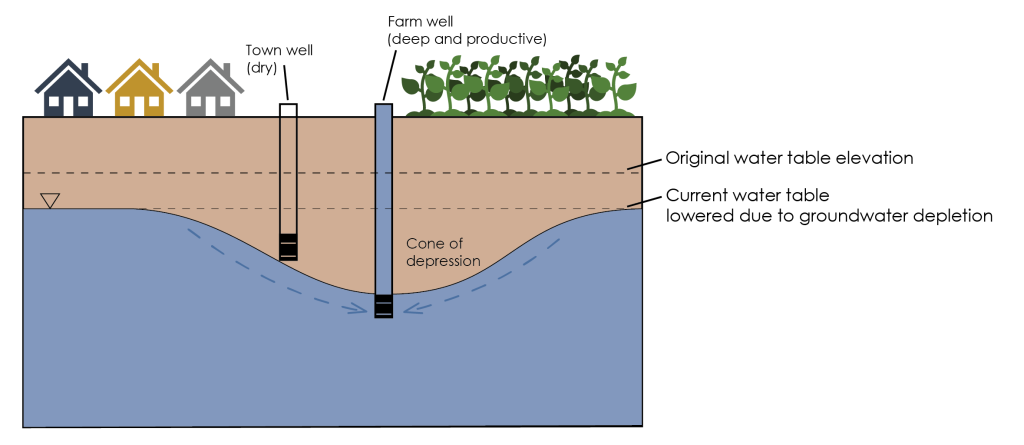
Cone of depression forms around pumping wells
The water table represents the boundary between unsaturated soil above and water-saturated soil below. Its level fluctuates based on recharge (water entering) versus discharge (water leaving) the groundwater system.
Factors Affecting Water Table
Factor | Effect on Water Table | Mechanism |
|---|---|---|
Excessive Pumping | Lowers | Groundwater extraction exceeds recharge |
Reduced Rainfall | Lowers | Less infiltration and aquifer recharge |
Riverbed Deepening | Lowers | Creates drainage pathway for groundwater |
Urbanization | Lowers | Concrete reduces infiltration, increases runoff |
Monsoon Season | Raises | Heavy rainfall increases recharge |
Water Table Diagram
Source: minnstate.pressbooks.pub — 2A.5 Impacts of Groundwater Withdrawals for Irrigation ... · minnstate.pressbooks.pub
Sand Mining Water Table Impact
%%{init: {"flowchart": {"wrappingWidth": 460}}}%%
flowchart TD
  s1["`**Sand Removal**
Creates deeper riverbed and exposed areas`"]
  s2["`**Hydraulic Connection**
Groundwater flows toward lower riverbed level`"]
  s3["`**Regional Drainage**
Water table drops in surrounding areas`"]
  s4["`**Well Impact**
Nearby wells may dry up or yield less water`"]
  s1 --> s2
  s2 --> s3
  s3 --> s4
Consequences of Lowered Water Table
Agricultural impact: Crops lose access to groundwater, irrigation costs increase
Domestic wells: Traditional wells dry up, deeper boring required
Land subsidence: Soil compacts when groundwater support is removed
Vegetation stress: Trees and plants cannot reach water, leading to die-back