The term "two-state solution" is sometimes mentioned in the news in the context of the affairs of
Contents14
- AChina
- BIsrael
- CIraq
- DYemen
Show answer
Answer: (B) Israel
Correct Answer: (b) Israel
The 'two-state solution' refers to a proposed solution to the Israel-Palestine conflict. The idea is that:
- Israel would continue as an independent Jewish state
- Palestine would become an independent state alongside Israel
This has been the internationally accepted framework for peace since the 1990s (Oslo Accords), though it remains unrealized.
Why the other options are wrong:
- China — Issues like Taiwan or Hong Kong are not described as a 'two-state solution.'
- Iraq — Iraq has internal conflicts (Kurds, Sunni-Shia divide) but the phrase 'two-state solution' is not used for them.
- Yemen — Yemen has a civil war between Houthi rebels and the government, but again, 'two-state solution' is not the standard term used.
REMEMBER: 'Two-state solution' = Israel + Palestine living side by side as independent states. This phrase almost always refers to the Israel-Palestine conflict.
The two-state solution refers specifically to creating independent Israeli and Palestinian states side by side, based on the Oslo Accords framework from the 1990s.
US foreign policy under Trump shifted significantly on Israel-Palestine issues around 2017-2018, making this a current topic when the question was asked.
UPSC is testing whether students can distinguish between different types of international conflicts and the specific terminology used for each.
Two-State Solution: Israel-Palestine
World Affairs (International Relations) two-state solution
Two-State Solution: Israel-Palestine Peace Framework
Two-state solution = Israel + Palestine as independent states side by side
Oslo Accords (1993) established this as the international framework
Remains unresolved due to settlements, borders, and security disputes
Palestine would comprise West Bank + Gaza Strip with East Jerusalem as capital
What It Means
The two-state solution is the internationally accepted framework for resolving the Israel-Palestine conflict. It envisions Israel continuing as a Jewish state alongside a new Palestinian state - both sovereign and independent.
The Two Proposed States
State | Territory | Capital | Current Status |
|---|---|---|---|
Israel | Pre-1967 borders + agreed land swaps | West Jerusalem | Existing sovereign state |
Palestine | West Bank + Gaza Strip | East Jerusalem | Occupied territories, no sovereignty |
Key Milestones
Oslo Accords (1993): First formal agreement between Israel and PLO accepting mutual recognition
Camp David Summit (2000): Clinton-mediated talks failed over Jerusalem and refugee issues
Arab Peace Initiative (2002): Arab League offered full normalization for complete withdrawal
Annapolis Conference (2007): Bush administration's attempt, ended without agreement
Question Context
UPSC chose this term because it's exclusively associated with Israel-Palestine conflict. No other conflict uses this specific phrase, making it a reliable identifier in news analysis.
Trap: Confusing with other Middle East conflicts - only Israel-Palestine uses 'two-state solution'
Trap: Thinking China-Taiwan uses this term - China calls it 'One Country, Two Systems'
Trap: Associating with Iraq's Kurdistan issue - called 'autonomy' not 'two-state'
Israel-Palestine Conflict Overview
World Affairs (International Relations) Israel Palestine
Israel-Palestine Conflict: Key Facts for UPSC
1948: Israel declared independence, first Arab-Israeli war began
1967 Six-Day War: Israel occupied West Bank, Gaza, East Jerusalem
PLO (Palestine Liberation Organization) represents Palestinian interests
Hamas controls Gaza, Fatah controls West Bank government
Territorial Overview
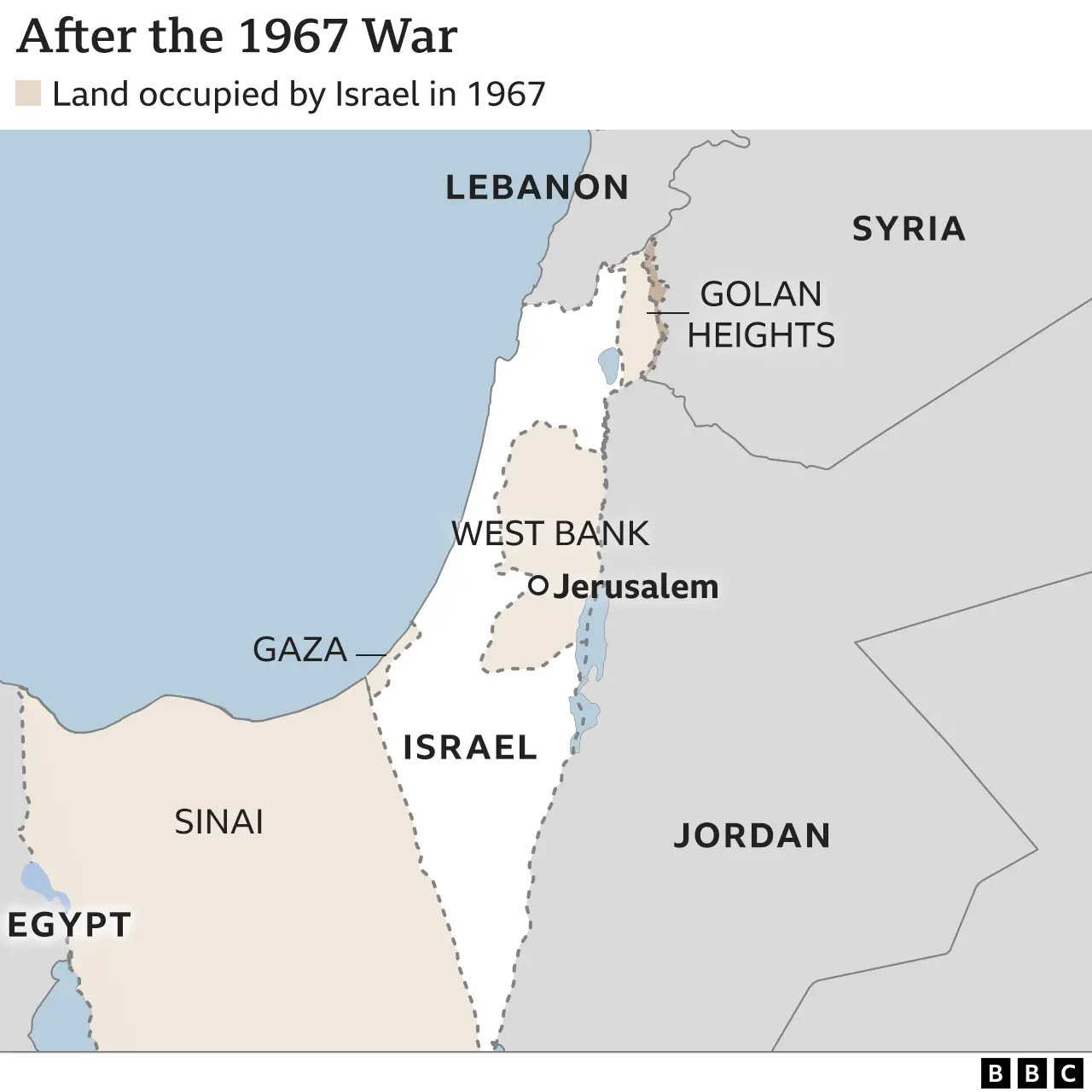
Source: BBC — Israel's borders explained in maps · www.bbc.com
Key Territories
Territory | Area | Population | Controlled By | Status Since 1967 |
|---|---|---|---|---|
West Bank | 5,860 sq km | ~3 million Palestinians | Israel (military occupation) | Occupied territory |
Gaza Strip | 365 sq km | ~2 million Palestinians | Hamas (de facto) | Occupied, then withdrawn 2005 |
East Jerusalem | 70 sq km | ~350,000 Palestinians | Israel (annexed) | Occupied, annexed 1980 |
Major Issues
Settlements: Israeli civilian communities built in occupied territories, considered illegal under international law
Refugees: ~5 million Palestinian refugees globally, 'right of return' disputed
Security Wall: Israeli barrier separating West Bank, affects Palestinian movement
Gaza Blockade: Israel-Egypt restrictions on Gaza since Hamas took control (2007)
India's Position
India supports Palestinian statehood and two-state solution while maintaining diplomatic ties with Israel. India was among the first to recognize PLO (1974) and Palestine as a state (1988), but expanded Israel cooperation significantly after 1992.
Middle East Conflicts: Key Distinctions
World Affairs (International Relations) China Iraq Yemen
Middle East Conflicts: What UPSC Tests vs Two-State Solution
Why Other Options Failed
UPSC included China, Iraq, Yemen as distractors because they have territorial/political disputes, but none use the term 'two-state solution' - this phrase is exclusively reserved for Israel-Palestine.
Regional Conflicts vs Two-State Framework
Country/Region | Main Conflict | Solution Framework | Why Not 'Two-State' |
|---|---|---|---|
China-Taiwan | Sovereignty dispute | 'One Country, Two Systems' | China rejects Taiwan independence |
Iraq | Kurdish autonomy, Sunni-Shia tensions | Federal autonomy | Kurdistan has autonomy within Iraq |
Yemen | Houthis vs Government | Ceasefire + unity government | Civil war, not partition demand |
Syria | Assad vs Opposition | Political transition | Regime change focus, not partition |
Current Middle East Hotspots
Yemen Civil War: Iran-backed Houthis vs Saudi-backed government, humanitarian crisis
Syria Conflict: Assad regime vs opposition, Russian/Iranian support for government
Iraq Stability: ISIS defeated but sectarian tensions remain, Kurdish autonomy established
Iran Nuclear Issue: JCPOA (Iran nuclear deal) disputes with US sanctions
Trap: Kurdistan autonomy in Iraq - called 'federal arrangement', not 'two-state solution'
Trap: Yemen's North-South division - it's a civil war, not a partition proposal
Trap: Any China territorial issue - Beijing always emphasizes 'One China' principle