Recently there was a proposal to translocate some of the lions from their habitat in Gujarat to which one of the following sites?
Contents14
- ACorbett National Park
- BKuno Palpur Wildlife Sanctuary
- CMudumalai Wildlife Sanctuary
- DSariska National Park
Show answer
Answer: (B) Kuno Palpur Wildlife Sanctuary
Kuno Palpur Wildlife Sanctuary (now Kuno National Park) in Madhya Pradesh was approved by an expert committee of the Ministry of Environment as the second home for Asiatic lions, which are currently found only in and around Gir National Park in Gujarat.
The rationale is simple: having all Asiatic lions in one location (Gir) makes the entire species vulnerable to a single catastrophic event like an epidemic, forest fire, or natural disaster.
Creating a second viable population elsewhere would serve as an 'insurance' against extinction.
Kuno Palpur was selected because of its suitable habitat, prey base, and proximity to other protected areas.
However, the Gujarat government has been reluctant to share its lions, citing various concerns and demanding that multiple studies be completed first.
The Supreme Court in 2013 directed the translocation of some lions to Kuno, but it has faced political and bureaucratic delays.
Corbett National Park (Uttarakhand) is primarily a tiger reserve.
Mudumalai (Tamil Nadu) is known for elephants and tigers.
Sariska (Rajasthan) is associated with tiger reintroduction.
None of these were the proposed site for lion translocation.
Asiatic lions exist only in Gujarat's Gir forest, making the entire species vulnerable to a single catastrophic event like disease or natural disaster.
The Supreme Court ordered lion translocation to Kuno in 2013, but Gujarat has resisted sharing its lions, making this a recurring exam topic about wildlife conservation versus state politics.
UPSC is testing whether students can distinguish between different translocation projects - lions to Kuno, tigers to Sariska, rather than mixing up various wildlife reintroduction programs.
Asiatic Lion Conservation
Environment lions Gujarat translocate
Asiatic Lions: Last Population & Conservation Strategy
Asiatic lions exist only in Gir National Park, Gujarat — world's last wild population
Single-location risk: entire species vulnerable to one catastrophic event
Kuno National Park, MP approved as second home but translocation stalled
Supreme Court 2013 directed translocation but Gujarat government resisted
Conservation Crisis
Asiatic lions (Panthera leo persica) are found only in and around Gir National Park in Gujarat — making them one of the world's most geographically restricted big cats. This concentration creates extreme vulnerability: a single epidemic, forest fire, or natural disaster could wipe out the entire species.
The translocation strategy aims to establish a second viable population elsewhere, serving as biological insurance against extinction.
Asiatic vs African Lions
Feature | Asiatic Lion | African Lion |
|---|---|---|
Scientific Name | Panthera leo persica | Panthera leo leo |
Current Range | Gir Forest, Gujarat only | Sub-Saharan Africa |
Population | ~675 (2020 census) | ~20,000-25,000 |
Physical Difference | Belly fold, smaller mane | Larger mane, no belly fold |
IUCN Status | Endangered | Vulnerable |
Gir Forest Location
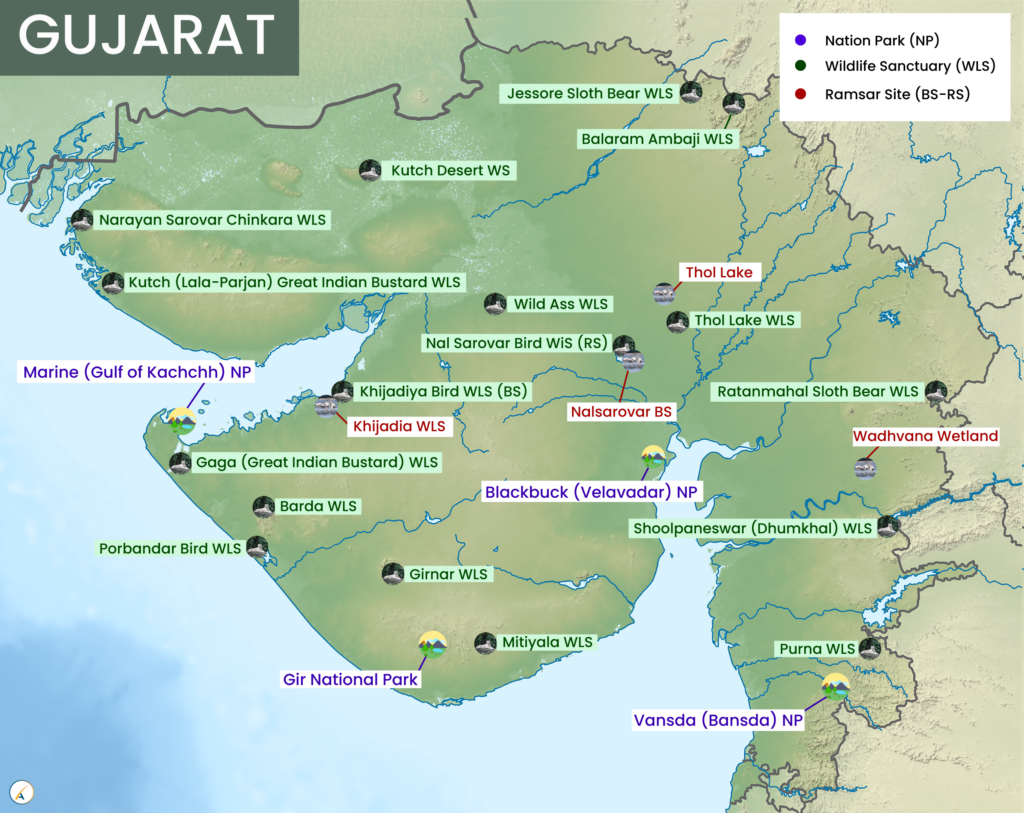
Source: LotusArise — Gujarat National Parks, Wildlife Sanctuaries & Ramsar Sites · lotusarise.com
Trap: Confusing translocation site — only Kuno was officially approved, not Corbett/Sariska
Trap: Mixing up Asiatic lions (Gir only) with tigers (multiple reserves across India)
Trap: Assuming lions exist in multiple Indian locations — they don't, only Gujarat
Kuno National Park & Translocation Project
Environment Kuno Palpur Wildlife Sanctuary translocate
Kuno National Park: Selected Site for Lion Translocation
Kuno National Park (formerly Kuno Palpur Wildlife Sanctuary) in Madhya Pradesh
Expert committee approved it as second home for Asiatic lions
Gujarat resistance has stalled translocation despite Supreme Court order
24 villages relocated to prepare habitat for lions
Why Kuno Was Chosen
Kuno National Park in Madhya Pradesh was selected after extensive habitat assessment by expert committees. The park offers suitable prey base, appropriate terrain, and connectivity to other protected areas. Most importantly, 24 villages were relocated from the core area to create a disturbance-free environment for lions.
Selection Criteria Met
Adequate prey base: spotted deer, sambhar, nilgai, wild boar populations
Suitable habitat: dry deciduous forests similar to Gir ecosystem
Strategic location: connects to other MP protected areas
Human-wildlife conflict mitigation: villages already relocated
Expert validation: multiple committees approved the site
Translocation Timeline
%%{init: {"flowchart": {"wrappingWidth": 460}}}%%
flowchart TD
  s1["`**2004-2012**
Habitat preparation, village relocation, prey augmentation at Kuno`"]
  s2["`**2013**
**Supreme Court** ordered translocation of lions from Gir to Kuno`"]
  s3["`**2013-Present**
**Gujarat government resistance** citing need for more studies`"]
  s4["`**2020**
Kuno upgraded to **National Park** status, cheetah reintroduction began instead`"]
  s1 --> s2
  s2 --> s3
  s3 --> s4
Current Status
Despite Supreme Court directions, Gujarat has not transferred any lions to Kuno, citing concerns about habitat readiness and demanding additional studies. Meanwhile, African cheetahs were introduced to Kuno in 2020 under a separate reintroduction program, adding complexity to the lion translocation plan.
Trap: Kuno is now a National Park, not Wildlife Sanctuary (upgraded in 2018)
Trap: Don't confuse with cheetah reintroduction — lions were the original translocation plan
Trap: Location is Madhya Pradesh, not neighboring states like Rajasthan
Major National Parks & Their Flagship Species
Environment Corbett National Park Mudumalai Wildlife Sanctuary Sariska National Park
Key Protected Areas: Flagship Species & Locations
Corbett (Uttarakhand) — India's first National Park, famous for tigers
Sariska (Rajasthan) — tiger reintroduction success story
Mudumalai (Tamil Nadu) — elephant corridor, part of Nilgiri Biosphere
None were suitable for lion translocation — different ecosystems
Comparison of Options
Protected Area | State | Established | Flagship Species | Key Feature |
|---|---|---|---|---|
Corbett National Park | Uttarakhand | 1936 | Bengal Tiger | India's first National Park |
Kuno National Park | Madhya Pradesh | 2018 | African Cheetah (reintroduced) | Selected for Asiatic Lion translocation |
Mudumalai Wildlife Sanctuary | Tamil Nadu | 1940 | Asian Elephant | Part of Nilgiri Biosphere Reserve |
Sariska National Park | Rajasthan | 1955 | Bengal Tiger | Tiger reintroduction (2008-2013) |
Geographic Distribution
# Protected Areas by Region
## North India
- **Corbett** - Uttarakhand
- **Kuno** - Madhya Pradesh
## West India
- **Sariska** - Rajasthan
- **Gir** - Gujarat
## South India
- **Mudumalai** - Tamil Nadu
- **Bandipur** - Karnataka
Why Others Were Unsuitable
Corbett: Cold Himalayan foothills — unsuitable for lions adapted to dry grasslands
Sariska: Semi-arid Rajasthan habitat — ongoing tiger recovery, would create competition
Mudumalai: Tropical moist forests in Western Ghats — wrong ecosystem type
Kuno advantage: Dry deciduous forests matching Gir's ecosystem type
Protected Areas Map
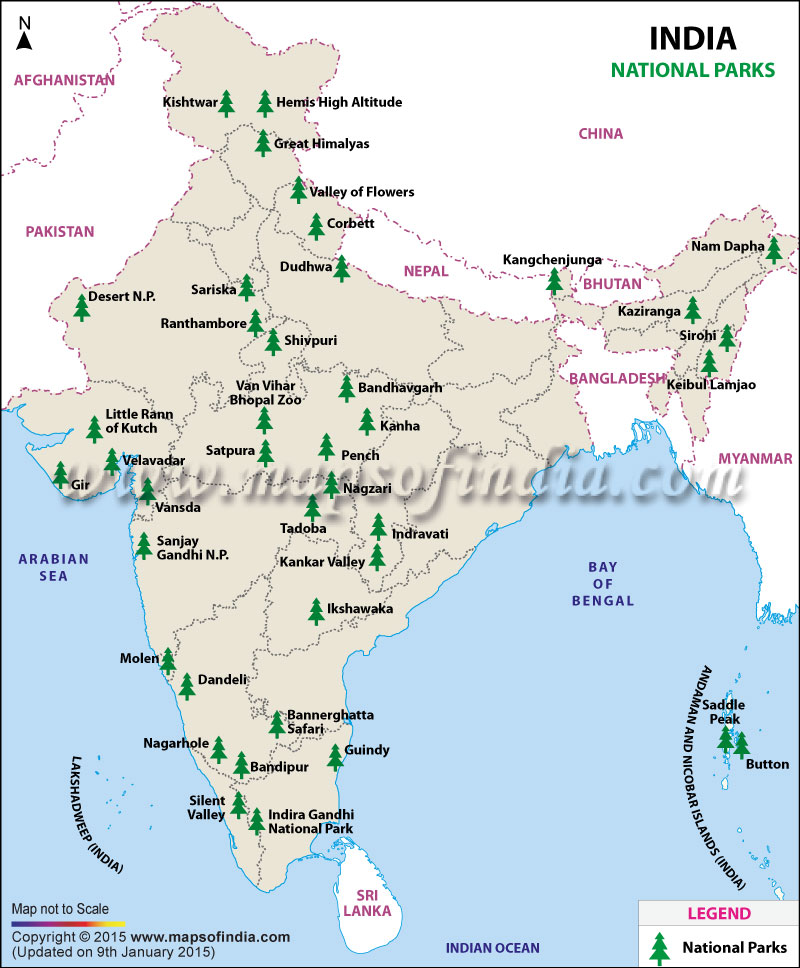
Source: India Map — List of National Parks in India , Map of National Parks in India · www.mapsofindia.com
Trap: Don't mix Sariska (tiger reintroduction) with Kuno (proposed lion translocation)
Trap: Mudumalai is a Wildlife Sanctuary, not National Park — but still protected
Trap: Corbett is India's oldest National Park (1936), not largest