Consider the following statements: 1. Climate and Clean Air Coalition (CCAC) to Reduce Short Lived Climate Pollutants is a unique initiative of G2O group of countries. 2. The CCAC focuses on methane, black carbon and hydrofluorocarbons. Which of the statements given above is/are correct?
Contents13
- A1 only
- B2 only
- CBoth 1 and 2
- DNeither 1 nor 2
Show answer
Answer: (B) 2 only
Statement 1 is incorrect:
The Climate and Clean Air Coalition (CCAC) is NOT a G20 initiative.
It was founded in 2012 by the governments of Bangladesh, Canada, Ghana, Mexico, Sweden, and the United States, along with the United Nations Environment Programme (UNEP).
It is a voluntary partnership of governments, intergovernmental organizations, businesses, and civil society.
As of now, it has 53 country partners, 17 international governmental organizations, and 45 NGO partners.
Notably, India is NOT a partner country, though The Energy and Resources Institute (TERI) is a partner NGO since 2015.
Statement 2 is correct:
CCAC focuses specifically on short-lived climate pollutants (SLCPs) — primarily methane, black carbon (soot), and hydrofluorocarbons (HFCs).
These pollutants have a relatively short atmospheric lifetime compared to CO2 but have a powerful warming effect.
Reducing these pollutants can deliver quick climate benefits.
So only statement 2 is correct.
CCAC targets short-lived climate pollutants like methane, black carbon, and HFCs that cause rapid warming but disappear faster than CO2, offering opportunities for quick climate benefits.
The coalition was founded by 6 countries including the US, Canada, and Mexico in 2012, not by the G20, and India is notably not a member despite being a major economy.
UPSC is testing whether students can distinguish between different international climate initiatives and their specific focus areas rather than assuming all climate bodies work on the same issues.
Climate and Clean Air Coalition (CCAC)
Environment Climate and Clean Air Coalition CCAC
Climate and Clean Air Coalition (CCAC): Formation, Partners & UPSC Traps
CCAC is a voluntary partnership founded in 2012 by 6 countries + UNEP, NOT a G20 initiative
India is NOT a partner country but TERI is a partner NGO since 2015
Focuses on Short-Lived Climate Pollutants (SLCPs) for quick climate benefits
Has 53 country partners, 17 international organizations, and 45 NGOs
The Climate and Clean Air Coalition is a voluntary partnership launched in 2012 to reduce short-lived climate pollutants that cause both climate change and air pollution. Unlike formal treaty-based organizations, CCAC operates through voluntary commitments and collaborative action.
CCAC Formation & Structure
Aspect | Details |
|---|---|
Founded | 2012 |
Founding Members | Bangladesh, Canada, Ghana, Mexico, Sweden, USA + UNEP |
Current Partners | 53 countries, 17 international organizations, 45 NGOs |
India's Status | NOT a partner country (TERI is partner NGO since 2015) |
Secretariat | UNEP (United Nations Environment Programme) |
Key Features
Voluntary partnership - no binding commitments, operates through collaborative action
Focus on rapid impact - targets pollutants with short atmospheric lifetimes but high warming potential
Multi-stakeholder approach - includes governments, businesses, and civil society organizations
Works through initiative-based action rather than formal treaty obligations
Trap: CCAC is NOT a G20 initiative - it was founded by 6 specific countries plus UNEP in 2012
India confusion: India is NOT a partner country, though TERI (an Indian NGO) is a partner
Don't confuse with UNFCCC or Paris Agreement - CCAC is a separate voluntary coalition
Short-Lived Climate Pollutants (SLCPs)
Environment methane black carbon hydrofluorocarbons Short Lived Climate Pollutants
Short-Lived Climate Pollutants: Methane, Black Carbon & HFCs
Three main SLCPs: methane, black carbon (soot), and hydrofluorocarbons (HFCs)
Short atmospheric lifetime but high warming potential compared to CO2
Reducing SLCPs can deliver quick climate benefits within decades
Also cause air pollution and health problems, creating co-benefits for reduction
Short-Lived Climate Pollutants (SLCPs) are substances that remain in the atmosphere for a relatively short time compared to CO2 but have a powerful warming effect. Reducing them offers the fastest way to slow climate change in the near term.
Key SLCPs Comparison
Pollutant | Atmospheric Lifetime | Warming Potential | Main Sources |
|---|---|---|---|
Methane (CH4) | ~12 years | 28x more potent than CO2 | Agriculture, livestock, landfills, oil & gas |
Black Carbon (Soot) | Days to weeks | 460-1,500x more potent | Diesel engines, biomass burning, cookstoves |
HFCs | 1-50 years | 1,000-9,000x more potent | Refrigerants, air conditioning, foam blowing |
Why SLCPs Matter
Dual impact: cause both climate warming and air pollution (unlike CO2 which only affects climate)
Quick benefits: reducing SLCPs can slow warming within 10-20 years, while CO2 benefits take centuries
Health co-benefits: reduction improves air quality and reduces respiratory diseases
Agricultural benefits: black carbon reduction can improve crop yields by reducing atmospheric haze
SLCP Sources
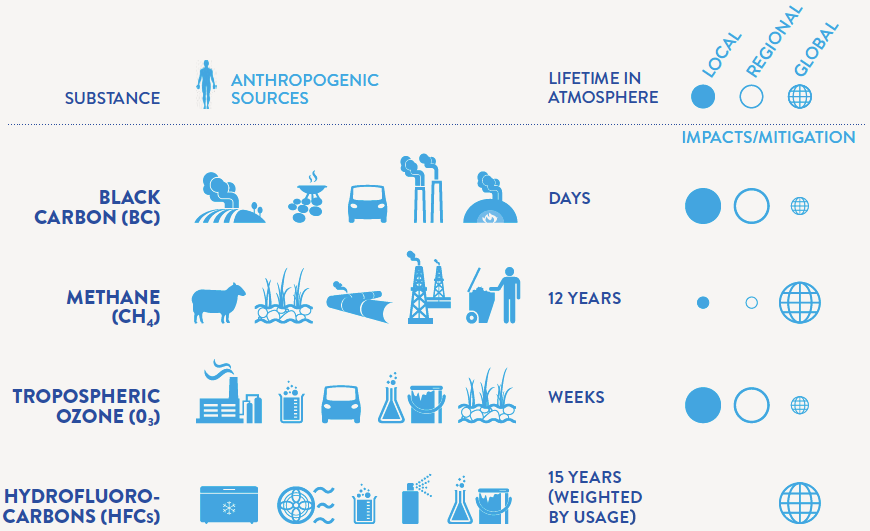
Source: Center for Climate and Energy Solutions (C2ES) — Short-lived Climate Pollutants - Center for Climate and Energy ... · www.c2es.org
All three SLCPs: methane, black carbon, AND HFCs - don't miss any in the list
Don't confuse black carbon with regular carbon dioxide - black carbon is soot particles
HFCs are refrigerants, not the same as CFCs (which deplete ozone layer)
International Climate Partnerships
Environment
International Climate Partnerships: Formal vs Voluntary Initiatives
Formal treaties: UNFCCC, Paris Agreement - legally binding commitments
Voluntary partnerships: CCAC, Mission Innovation - collaborative action without binding obligations
G20 climate role: coordinates among major economies, not a treaty-making body
UNEP partnerships: supports both formal negotiations and voluntary coalitions
Types of Climate Partnerships
Type | Examples | Nature | Participation |
|---|---|---|---|
UN Treaties | UNFCCC, Paris Agreement, Kyoto Protocol | Legally binding | Nearly universal (195+ countries) |
Voluntary Coalitions | CCAC, Mission Innovation, C40 Cities | Non-binding cooperation | Self-selecting partners |
Multilateral Groups | G20, G7 climate commitments | Political commitments | Fixed membership |
Sectoral Initiatives | International Solar Alliance, Global Methane Pledge | Sector-specific action | Relevant stakeholders |
Why Multiple Approaches Exist
Speed vs consensus: voluntary partnerships can act faster than formal treaties requiring consensus
Specific focus: coalitions like CCAC target narrow issues that formal treaties may not address adequately
Innovation space: allows experimentation with new approaches outside rigid treaty frameworks
Bridge-building: helps build trust and cooperation that can feed into formal negotiations
G20 creates commitments, NOT formal climate treaties - don't confuse with UNFCCC processes
CCAC is voluntary, Paris Agreement is binding - different legal status entirely
India's selective participation: member of Paris Agreement but NOT CCAC partner country
India's Climate Partnerships
Environment
India's Role in International Climate Partnerships
India is NOT a CCAC partner country but TERI is a partner NGO since 2015
India leads International Solar Alliance and is active in Paris Agreement
Focuses on South-South cooperation and climate justice in international forums
Selective participation based on national priorities and development needs
India's Climate Partnership Status
Initiative | India's Status | Reason/Focus |
|---|---|---|
CCAC | NOT a partner country | Prefers bilateral/multilateral over voluntary coalitions |
Paris Agreement | Active signatory | Committed to NDCs and climate action |
International Solar Alliance | Co-founder & headquarters | Leadership in renewable energy |
G20 | Member | Coordinates with major economies |
TERI in CCAC | Partner NGO since 2015 | Research and policy support |
India's Climate Diplomacy Approach
Principle of equity: emphasizes historical responsibility and per-capita emissions in climate discussions
Development priority: balances climate action with poverty alleviation and economic growth
Technology focus: promotes technology transfer and climate finance from developed countries
Leadership in renewables: uses International Solar Alliance to showcase clean energy leadership
TERI vs India: TERI (NGO) is CCAC partner, but India (country) is NOT
Don't assume India joins all climate initiatives - selective participation based on priorities
ISA leadership shows India's climate engagement, despite not joining some other coalitions like CCAC