In a pressure cooker, the temperature at which the food is cooked depends mainly upon which of the following? 1. Area of the hole in the lid 2. Temperature of the flame 3. Weight of the lid Select the correct answer using the code given below.
Contents16
- A1 and 2 only
- B2 and 3 only
- C1 and 3 only
- D1, 2 and 3
Show answer
Answer: (C) 1 and 3 only
In a pressure cooker, cooking temperature depends on internal pressure, which raises the boiling point of water.
Area of hole in lid (Option 1) is correct:
A smaller vent lets less steam escape, building higher pressure and higher cooking temperature.
A larger hole lets more steam out, lowering pressure and temperature.
Temperature of flame (Option 2) is wrong:
The flame heats water, but once boiling, cooking temperature depends on pressure, not flame intensity.
A stronger flame just makes water boil faster, not hotter.
Weight of lid (Option 3) is correct:
A heavier lid keeps more steam trapped, building higher pressure and higher boiling point.
This same principle explains why cooking is harder at high altitudes — lower atmospheric pressure means water boils at a lower temperature.
Options 1 and 3 are correct.
Answer: (c).
Pressure cookers work by trapping steam to increase internal pressure, which raises water's boiling point above 100°C and cooks food faster.
The cooking temperature depends only on internal pressure (controlled by vent hole size and lid weight), not on how hot the flame is underneath.
UPSC is testing whether students understand the relationship between pressure and boiling point, a key physics concept with practical applications.
Pressure Cooking Physics
Science And Technology pressure cooker temperature cooking
Pressure Cooking: How Pressure Controls Temperature
Pressure cooker temperature depends on internal pressure, not flame intensity
Higher pressure → higher boiling point → higher cooking temperature
Area of vent hole and weight of lid control internal pressure
Flame temperature only affects how fast water reaches boiling point
Core Principle
A pressure cooker works on pressure-temperature relationship. When water is heated in a sealed container, steam cannot escape easily, building pressure. Higher pressure forces water molecules to stay liquid at temperatures above 100°C, raising the boiling point.
Factors That Control Cooking Temperature
Factor | Effect on Pressure | Effect on Temperature | UPSC Answer |
|---|---|---|---|
Area of hole in lid | Smaller hole = Higher pressure | Higher cooking temperature | ✓ Correct |
Temperature of flame | No effect on final pressure | No effect on final cooking temp | ✗ Wrong |
Weight of lid | Heavier lid = Higher pressure | Higher cooking temperature | ✓ Correct |
How Pressure Cooking Works
%%{init: {"flowchart": {"wrappingWidth": 460}}}%%
flowchart TD
  s1["`**Water heated in sealed container**
Flame heats water inside pressure cooker`"]
  s2["`**Steam builds up**
Water turns to steam but cannot escape easily`"]
  s3["`**Pressure increases**
Steam accumulates, raising internal pressure`"]
  s4["`**Boiling point rises**
Higher pressure forces water to boil above 100°C`"]
  s5["`**Food cooks at higher temperature**
Cooking happens at 110-120°C instead of 100°C`"]
  s1 --> s2
  s2 --> s3
  s3 --> s4
  s4 --> s5
Why Flame Temperature Doesn't Matter
Flame only heats water to boiling point — once boiling starts, extra heat turns water to steam at the same temperature
Stronger flame = faster boiling, not hotter boiling — cooking temperature is determined by pressure, not heat input
Steam temperature rises only with pressure — atmospheric pressure determines normal boiling point at 100°C
Question Connection
This question tests understanding that pressure, not heat intensity, controls cooking temperature in pressure cookers. Option 2 (flame temperature) is the classic trap — students think more heat = higher temperature, missing that pressure is the key factor.
Trap: Thinking flame temperature affects cooking temperature — it only affects how fast you reach boiling point
Trap: Missing that weight of lid matters — heavier lid traps more steam, building higher pressure
Trap: Assuming all three factors matter equally — pressure control (options 1&3) vs heat input (option 2) work differently
Pressure-Temperature Relationship
Science And Technology pressure temperature boiling point
Pressure-Temperature Relationship in Liquids & Gases
Higher pressure = higher boiling point for any liquid
At 1 atm pressure, water boils at 100°C
In pressure cooker, 2 atm pressure raises boiling point to 120°C
At high altitudes, lower pressure means water boils below 100°C
Scientific Basis
Vapor pressure determines when a liquid boils. A liquid boils when its vapor pressure equals atmospheric pressure. Higher external pressure requires higher temperature for vapor pressure to match, raising the boiling point.
Boiling Point at Different Pressures
Pressure (atm) | Water Boiling Point | Context | Cooking Implication |
|---|---|---|---|
0.5 atm | 82°C | High altitude (Mt. Everest) | Food cooks poorly |
1.0 atm | 100°C | Sea level (normal) | Standard cooking |
1.5 atm | 112°C | Pressure cooker (low) | Faster cooking |
2.0 atm | 120°C | Pressure cooker (high) | Much faster cooking |
Real-World Applications
High-altitude cooking takes longer because water boils at lower temperature due to reduced atmospheric pressure
Autoclave sterilization uses high pressure (15-20 psi) to reach 121°C for killing bacteria
Industrial boilers operate under pressure to achieve higher steam temperatures for efficiency
Pressure vs Temperature Graph
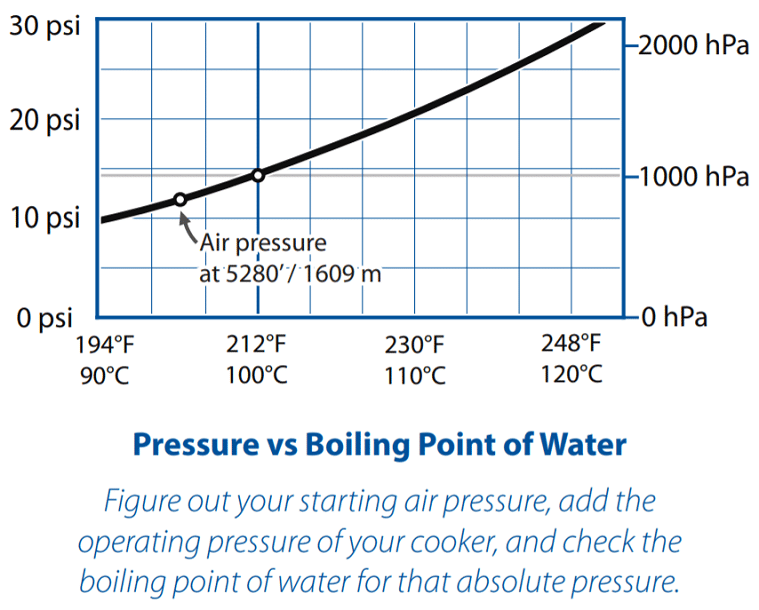
Source: Eating Rules — The Science of Pressure Cookers - Eating Rules · eatingrules.com
Altitude Effects on Cooking
Science And Technology
Why Cooking is Difficult at High Altitudes
Lower atmospheric pressure at altitude reduces water's boiling point
At 3000m altitude, water boils at 90°C instead of 100°C
Food cooks slower and poorly because of lower cooking temperature
The Physics
Atmospheric pressure decreases with altitude because there's less air above pressing down. Lower pressure means water molecules can escape as vapor more easily, so boiling happens at lower temperatures.
Altitude vs Boiling Point
Altitude | Atmospheric Pressure | Water Boiling Point | Cooking Impact |
|---|---|---|---|
Sea level | 1.0 atm | 100°C | Normal cooking |
1500m (Shimla) | 0.85 atm | 95°C | Slightly longer cooking |
3000m (Leh) | 0.69 atm | 90°C | Much longer cooking |
5500m (Everest Base) | 0.50 atm | 82°C | Very difficult cooking |
Solutions for High-Altitude Cooking
Pressure cookers become essential — they restore higher pressure and temperature
Cooking times must be increased — rice that takes 10 minutes at sea level needs 20+ minutes
Baking recipes need adjustment — lower pressure affects how dough rises
UPSC Connection
This concept explains why the question mentions that weight of lid matters — a heavier lid counters the reduced atmospheric pressure at altitude, maintaining higher internal pressure for proper cooking temperatures.