Which one of the following is a reason why astronomical distances are measured in light-years?
Contents17
- ADistances among stellar bodies do not change.
- BGravity of stellar bodies does not change.
- CLight always travels in straight line.
- DSpeed of light is always same.
Show answer
Answer: (D) Speed of light is always same.
Astronomical distances are measured in light-years because the speed of light is constant — about 300,000 km/sec — everywhere in the universe.
This constancy (a cornerstone of Einstein's relativity) makes it a reliable measuring stick.
A light-year equals the distance light travels in one year (about 9.46 trillion km).
Since stellar distances are enormous, using km would give impractically large numbers.
The constant speed of light means one light-year is always the same distance.
The other options are either incorrect or irrelevant.
Answer: (d).
A light-year is the distance light travels in one year, approximately 9.46 trillion kilometers, making it useful for measuring vast stellar distances that would otherwise require impractically large numbers.
The speed of light being constant everywhere in the universe is a fundamental principle of Einstein's theory of relativity, making it a reliable universal measuring standard.
The question tests understanding of why we need special units for astronomical measurements and what physical constant makes light-years scientifically valid.
Light-Year as Distance Unit
Science And Technology light-years astronomical distances
Light-Year: Definition, Calculation & Why It's Used
Light-year = distance light travels in one year ≈ 9.46 trillion km
Used because speed of light is constant everywhere in universe
Makes astronomical distances manageable vs using kilometers
Based on Einstein's relativity principle of constant light speed
Why Light-Years?
Astronomical distances are so vast that using kilometers creates unwieldy numbers. The speed of light is constant at approximately 300,000 km/sec throughout the universe — a fundamental principle of Einstein's relativity. This constancy makes light an ideal measuring stick for space.
Distance Comparisons
Object | Distance from Earth | In Kilometers | In Light-Years |
|---|---|---|---|
Sun | Nearest star | 150 million km | 8.3 light-minutes |
Proxima Centauri | Nearest star (other than Sun) | 40 trillion km | 4.24 light-years |
Milky Way diameter | Our galaxy | 946,000 trillion km | 100,000 light-years |
Andromeda Galaxy | Nearest major galaxy | 24 quintillion km | 2.5 million light-years |
Key Properties
Light-year is distance, not time — measures how far light travels in one year
Calculation: 300,000 km/sec × 31,557,600 sec/year = 9.46 trillion km
Practical advantage: Proxima Centauri is 4.24 light-years away vs 40 trillion km
Scientific basis: Relies on c (speed of light) being universal constant
Question Context
This question tests understanding that light-years work as a unit because speed of light never changes. The other options are incorrect: stellar distances do change over time, gravity varies, and light can bend around massive objects.
Trap: Option A — stellar distances do change over cosmic time due to orbital motion
Trap: Option B — gravity varies between different stellar bodies and locations
Trap: Option C — light bends around massive objects due to gravitational lensing
Common confusion: Light-year measures distance, not time duration
Speed of Light as Universal Constant
Science And Technology speed of light constant
Speed of Light: Universal Constant in Physics
Speed of light c = 299,792,458 m/sec (approximately 300,000 km/sec)
Constant everywhere in vacuum regardless of observer or source motion
Fundamental postulate of Einstein's Special Relativity (1905)
Forms basis for space-time measurements and E=mc²
Why It's Constant
Unlike sound or water waves, light doesn't need a medium. In vacuum, electromagnetic radiation always travels at c regardless of the motion of source or observer. This invariance is what makes light speed a universal measuring standard.
Light Speed in Different Media
Medium | Speed | Refractive Index | Example |
|---|---|---|---|
Vacuum/Air | 300,000 km/sec | 1.0 | Space, atmosphere |
Water | 225,000 km/sec | 1.33 | Ocean, rivers |
Glass | 200,000 km/sec | 1.5 | Optical fibers |
Diamond | 125,000 km/sec | 2.4 | Jewelry, cutting tools |
Scientific Implications
Universal speed limit — nothing can travel faster than light in vacuum
Time dilation and length contraction occur as objects approach light speed
Mass-energy equivalence: E=mc² uses light speed as conversion factor
Causality principle — cause-effect relationships preserved across reference frames
Light slows down in media like water/glass — constant only refers to vacuum
Speed changes but frequency stays same when light enters different medium
c is exact value by definition — meter is now defined using light speed
Astronomical Distance Units
Science And Technology astronomical distances
Units for Measuring Space: AU, Light-Year & Parsec
AU (Astronomical Unit) = 150 million km = Earth-Sun distance
Light-year = 9.46 trillion km = distance light travels in one year
Parsec = 3.26 light-years = parallax-based unit for stellar distances
Choice depends on scale: AU for solar system, ly for galaxy, parsec for precision
Distance Unit Comparison
Unit | Value | Best Used For | Example Distance |
|---|---|---|---|
Kilometer | 1,000 m | Earth distances | Mumbai-Delhi: 1,400 km |
AU | 150 million km | Solar System | Jupiter: 5.2 AU from Sun |
Light-Year | 9.46 trillion km | Stellar distances | Alpha Centauri: 4.37 ly |
Parsec | 3.26 light-years | Professional astronomy | Nearby stars: 1-100 parsec |
Kiloparsec | 1,000 parsec | Galactic scale | Milky Way: 30 kpc diameter |
Megaparsec | 1 million parsec | Cosmic distances | Andromeda: 0.78 Mpc away |
Why Different Units?
Scale problem: Using km for galaxy distances gives numbers with 20+ digits
AU convenient for planets — Jupiter at 5.2 AU easier than 778 million km
Light-year intuitive — shows how long light takes to reach us from stars
Parsec preferred by astronomers — based on parallax measurement technique
Scale Visualization
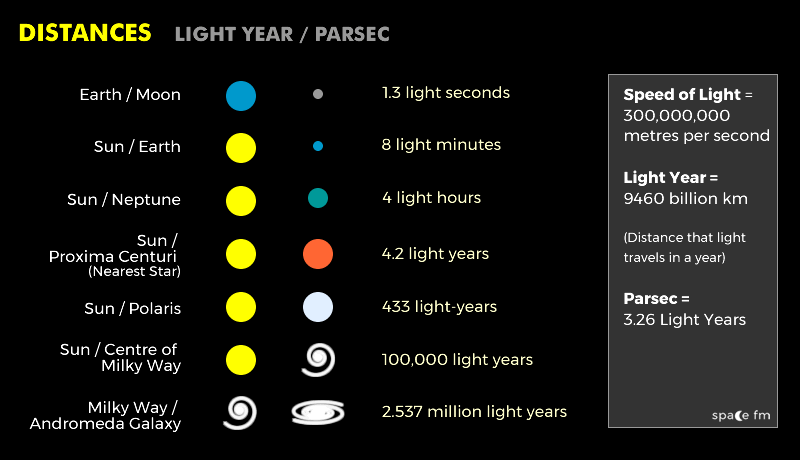
Source: Space FM — Light Year and Parsec | Starlight | Space FM · www.space.fm
Stellar Distances & Gravity Variations
Science And Technology stellar bodies gravity
Why Stellar Distances & Gravity Change (Wrong Options Explained)
Stellar distances do change due to orbital motion and stellar drift
Gravity varies significantly between different stellar bodies
Only speed of light remains constant — making it reliable for measurement
Light can bend around massive objects (gravitational lensing)
Why Option A is Wrong
Stars orbit around galactic center — Sun completes orbit every 225-250 million years
Binary star systems have stars orbiting each other, changing relative distances
Stellar proper motion — stars drift across sky over time due to individual velocities
Example: Barnard's Star moves 10.3 arcseconds per year — fastest known proper motion
Gravity Variations (Why Option B is Wrong)
Object | Surface Gravity | Compared to Earth | Mass |
|---|---|---|---|
Earth | 9.8 m/s² | 1.0× | 5.97 × 10²⁴ kg |
Sun | 274 m/s² | 28× | 1.99 × 10³⁰ kg |
White Dwarf | 10⁶ m/s² | 100,000× | 0.6 solar masses |
Neutron Star | 10¹¹ m/s² | 10 billion× | 1.4 solar masses |
Moon | 1.6 m/s² | 0.16× | 7.35 × 10²² kg |
Why Option C is Wrong
Gravitational lensing — massive objects bend light paths around them
Atmospheric refraction — Earth's atmosphere bends starlight, causing twinkling
Interstellar medium can scatter and deflect light
Light travels in straight line only in uniform medium — not always the case in space
Don't assume stellar distances are fixed — everything in space is in motion
Gravity varies enormously — from asteroid (nearly zero) to neutron star (crushing)
Light bending is real — observed during solar eclipses and in galaxy clusters
Only speed of light in vacuum is truly constant and universal