Consider the following statements: 1. Biofilms can form on medical implants within human tissues. 2. Biofilms can form on food and food processing surfaces. 3. Biofilms can exhibit antibiotic resistance. Which of the statements given above are correct?
Contents16
- A1 and 2 only
- B2 and 3 only
- C1 and 3 only
- D1, 2 and 3
Show answer
Answer: (D) 1, 2 and 3
The answer is (D) All three are correct.
Biofilms are thin layers of microorganisms (mostly bacteria) that stick to surfaces and form a protective "shield" around themselves.
Statement 1 is CORRECT:
Biofilms can form on medical implants like catheters, artificial joints, and heart valves inside the human body.
This is a major cause of hospital infections.
Statement 2 is CORRECT:
Biofilms love food processing surfaces.
They can form on equipment, contaminating food products.
This is a constant hygiene concern in food factories.
Statement 3 is CORRECT:
The biofilm acts like armor for bacteria.
Antibiotics that would normally kill bacteria struggle to penetrate this protective layer.
This makes biofilm infections very difficult to treat.
Think of biofilm as bacteria building a fort around themselves — it protects them from antibiotics, cleaning agents, and harsh conditions.
Biofilms cause major problems in hospitals and food industries because bacteria in biofilms are much harder to kill than individual bacteria.
COVID-19 increased focus on hospital-acquired infections, making biofilm resistance on medical devices a critical healthcare issue that UPSC began testing.
The question tests whether students understand biofilms as a protective mechanism rather than just knowing they exist on surfaces.
Biofilms: Definition & Formation
Science And Technology Biofilms
Biofilms: Structure, Formation & Key Properties
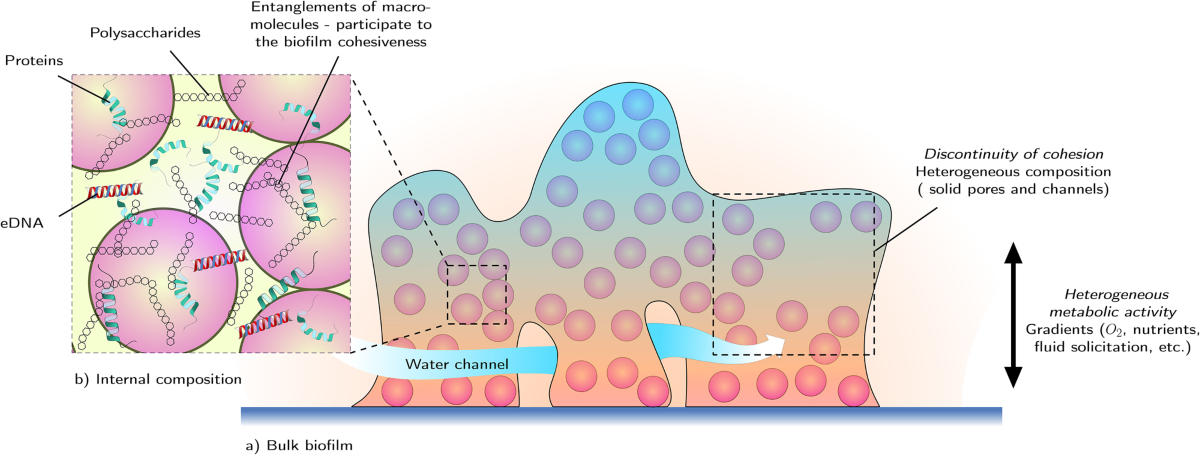
Biofilms are structured communities of microorganisms encased in a self-produced protective matrix
Form on virtually any surface - medical devices, food equipment, natural environments
Exhibit antibiotic resistance due to protective matrix barrier
Major cause of hospital-acquired infections and food contamination
What Are Biofilms
Biofilms are thin layers of microorganisms (primarily bacteria) that adhere to surfaces and encase themselves in a self-produced protective matrix. Think of them as bacterial cities with their own infrastructure and defense systems.
Structure: Microorganisms + extracellular polymeric substances (EPS)
Formation: Bacteria attach to surface → multiply → produce protective matrix
Characteristics: Highly organized, resistant to environmental stress
Biofilm Formation Process
%%{init: {"flowchart": {"wrappingWidth": 460}}}%%
flowchart TD
  s1["`**Initial Attachment**
Free-floating bacteria adhere to surface`"]
  s2["`**Irreversible Attachment**
Bacteria produce adhesive substances, firmly attach`"]
  s3["`**Microcolony Formation**
Cell division creates small bacterial clusters`"]
  s4["`**Maturation**
EPS matrix formation, complex 3D structure develops`"]
  s5["`**Dispersion**
Some bacteria detach to colonize new surfaces`"]
  s1 --> s2
  s2 --> s3
  s3 --> s4
  s4 --> s5
Biofilm Structure
Source: Nature — Towards standardized mechanical characterization of ... · www.nature.com
Medical Device Biofilms
Science And Technology medical implants human tissues
Biofilms on Medical Implants: Major Healthcare Challenge
Biofilms form on catheters, artificial joints, heart valves within human body
Major cause of hospital-acquired infections - difficult to treat
65% of hospital infections involve biofilms
Common Medical Device Biofilms
Medical Device | Infection Type | Common Bacteria | Treatment Challenge |
|---|---|---|---|
Catheters (urinary, central line) | Catheter-associated UTI/bloodstream | Staphylococcus, E.coli | Often requires device removal |
Artificial joints | Prosthetic joint infection | Staphylococcus aureus | Revision surgery needed |
Heart valves | Endocarditis | Streptococcus, Enterococcus | Life-threatening, valve replacement |
Dental implants | Peri-implantitis | Oral bacteria | Implant failure risk |
Why Medical Biofilms Are Dangerous
Immune evasion: EPS matrix shields bacteria from white blood cells
Persistent infection: Survive in body despite immune response and antibiotics
Device failure: Can cause mechanical problems with implants
Systemic spread: Bacteria can detach and cause secondary infections
Economic burden: Increased hospital stays, revision surgeries
Statement 1 is correct: Biofilms definitely form on medical implants - this is well-established medical fact
Don't confuse biofilms with simple bacterial colonization - biofilms have organized structure
Food Industry Biofilms
Science And Technology food food processing surfaces
Biofilms in Food Processing: Safety & Contamination Risks
Biofilms form on food processing equipment - major contamination source
Listeria, Salmonella, E.coli commonly form biofilms in food facilities
Resistant to standard cleaning - require specialized removal methods
Food Industry Biofilm Locations
Equipment/Surface | Common Pathogens | Food Products Affected | Risk Level |
|---|---|---|---|
Conveyor belts | Listeria monocytogenes | Ready-to-eat foods | High |
Storage tanks | Salmonella spp. | Dairy, beverages | High |
Cutting surfaces | E.coli, Campylobacter | Meat, poultry | Very High |
Pipes and drains | Mixed bacterial communities | All processed foods | Medium |
Heat exchangers | Bacillus spp. | Heat-treated products | Medium |
Food Safety Challenges
Cross-contamination: Biofilms continuously shed bacteria onto food products
Cleaning resistance: Standard sanitizers cannot penetrate biofilm matrix effectively
Temperature tolerance: Some biofilm bacteria survive pasteurization temperatures
Economic losses: Product recalls, facility shutdowns, brand damage
Regulatory compliance: Food safety agencies require biofilm prevention protocols
Prevention Strategies
Food industries use combination approaches: mechanical removal (high-pressure washing), chemical treatments (enzymatic cleaners), and HACCP protocols. Regular equipment disassembly and specialized biofilm-targeting sanitizers are essential.
Enzymatic cleaners break down EPS matrix
Quaternary ammonium compounds for surface treatment
Steam cleaning for heat-resistant surfaces
Statement 2 is correct: Biofilms definitely form on food processing surfaces - major food safety concern
Don't think biofilms only form in dirty conditions - they form even in clean facilities with proper hygiene
Biofilm Antibiotic Resistance
Science And Technology antibiotic resistance
Biofilm Antibiotic Resistance: Mechanisms & Clinical Impact
Biofilms show 10-1000 times higher antibiotic resistance than free bacteria
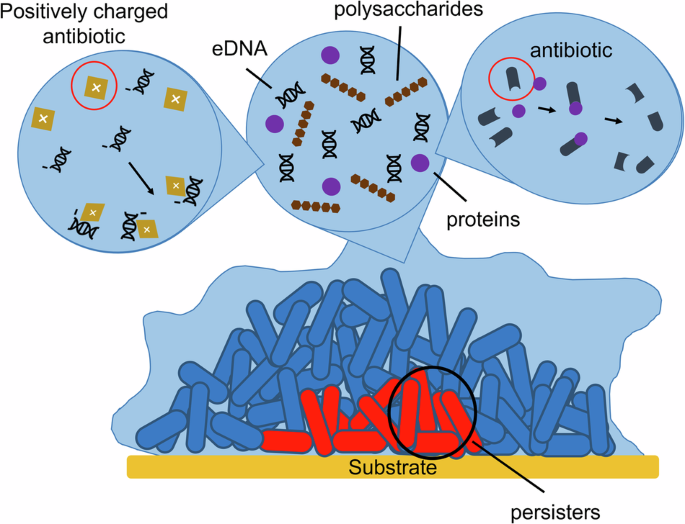
EPS matrix acts as physical barrier preventing drug penetration
Major cause of chronic infections and treatment failures
Persister cells within biofilms survive antibiotic treatment
Resistance Mechanisms
# Biofilm Antibiotic Resistance
## Physical Barriers
- EPS matrix blocks drug entry
- Reduced diffusion rate
- Drug sequestration
## Metabolic Changes
- Slow growth rate
- Altered gene expression
- Reduced metabolic activity
## Persister Cells
- Dormant subpopulation
- Survive treatment
- Regrow after antibiotic removal
## Microenvironment
- pH gradients
- Oxygen limitation
- Nutrient depletion
Biofilm vs Free Bacteria Resistance
Factor | Free-Floating Bacteria | Biofilm Bacteria | Resistance Increase |
|---|---|---|---|
Drug penetration | Direct contact | Matrix barrier | 100-1000x |
Growth rate | Rapid division | Slow/dormant | 10-100x |
Gene expression | Normal metabolism | Stress response | 5-50x |
Cell density | Dispersed | High local density | Variable |
Clinical Consequences
Treatment failure: Standard antibiotic courses ineffective against biofilm infections
Chronic infections: Biofilms persist despite apparent clinical improvement
Higher drug doses: May require toxic concentrations to penetrate biofilm
Combination therapy: Multiple antibiotics + biofilm-disrupting agents needed
Device removal: Often only solution for medical device biofilms
Resistance Mechanism
Source: Nature — Mechanisms of antimicrobial resistance in biofilms | npj ... · www.nature.com
Statement 3 is correct: Biofilms exhibit significant antibiotic resistance - well-documented phenomenon
Don't confuse with genetic resistance - biofilm resistance is physical + physiological, not just genetic mutations