The Government enacted, the Panchayat Extension to Scheduled Areas (PESA) Act in 1996. Which one of the following is not identified as its objective?
Contents12
- ATo provided self-governance
- BTo recognize traditional rights
- CTo create autonomous regions in tribal areas
- DTo free tribal people from exploitation
Show answer
Answer: (C) To create autonomous regions in tribal areas
The PESA Act (1996) extended the provisions of the 73rd Amendment (Panchayati Raj) to the tribal areas in the Fifth Schedule. Its objectives include:
(a) To provide self-governance — Yes, this is a core objective. PESA empowers Gram Sabhas in Scheduled Areas.
(b) To recognize traditional rights — Yes, PESA recognizes the competence of Gram Sabhas to safeguard and preserve traditions, customs, and community resources.
(d) To free tribal people from exploitation — Yes, PESA aims to protect tribals from exploitation by giving communities control over natural resources, minor forest produce, etc.
(c) To create autonomous regions in tribal areas — NO, this is NOT an objective of PESA. Autonomous regions/councils exist under the Sixth Schedule for North-Eastern states. PESA applies to Fifth Schedule Areas in nine states and works through the Panchayati Raj framework, not by creating autonomous regions.
So option (c) is the one NOT identified as a PESA objective.
PESA extends Panchayati Raj to tribal areas in nine states covering Fifth Schedule Areas, giving Gram Sabhas control over natural resources and traditional practices.
The trap here is confusing Fifth Schedule areas (where PESA applies through Panchayati Raj) with Sixth Schedule areas (which have autonomous district councils in Northeast states).
PESA Act 1996
Indian Polity PESA Panchayat Extension to Scheduled Areas
PESA Act 1996: Extending Panchayati Raj to Tribal Areas
PESA Act 1996 extends 73rd Amendment to Fifth Schedule Areas in 9 states
Empowers Gram Sabhas in tribal areas with special powers over resources and traditions
Does NOT create autonomous regions — that's Sixth Schedule
Protects tribal communities from exploitation through local control
What is PESA
The Panchayat Extension to Scheduled Areas Act 1996 bridges the gap between the 73rd Constitutional Amendment and tribal areas. While the 73rd Amendment established Panchayati Raj nationwide, it initially excluded Fifth Schedule Areas due to their special tribal character. PESA fills this gap by extending local self-governance to these areas with modifications suited to tribal customs.
PESA Objectives vs Options
Option | PESA Objective? | Explanation |
|---|---|---|
Self-governance | ✓ YES | Empowers Gram Sabhas with planning and implementation powers |
Recognize traditional rights | ✓ YES | Safeguards customs, traditions, and community resources |
Create autonomous regions | ✗ NO | This is Sixth Schedule function, not PESA |
Free tribals from exploitation | ✓ YES | Gives community control over minor forest produce, land transfers |
Key PESA Powers
Gram Sabha approval mandatory for all development plans in the village
Control over minor forest produce collection and sale
Power to prevent land alienation and restore illegally transferred land
Prior consent required for land acquisition and resettlement projects
Authority over local resources like water bodies, minor minerals
PESA Coverage Map
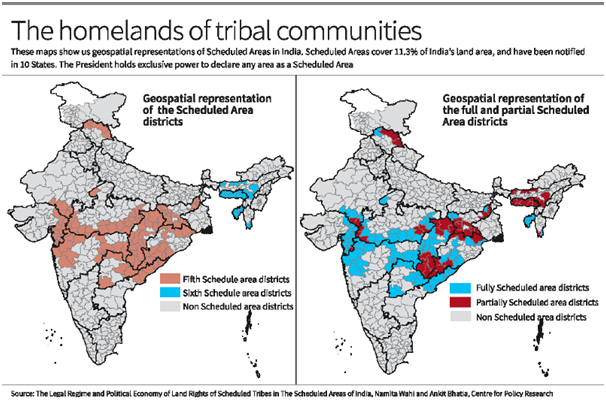
Source: Lukmaan IAS Blog — THE STATE OF INDIA'S SCHEDULED AREAS - Lukmaan IAS Mains Focus · blog.lukmaanias.com
Trap: Confusing PESA with Sixth Schedule — PESA is for Fifth Schedule Areas, not autonomous councils
Trap: Thinking PESA creates new institutions — it actually extends existing Panchayati Raj with modifications
Trap: Missing that PESA gives Gram Sabha more powers than regular Panchayats elsewhere
Common Error: Assuming all tribal areas are covered — only Fifth Schedule Areas get PESA, not Sixth Schedule areas in Northeast
Fifth vs Sixth Schedule Areas
Indian Polity Fifth Schedule Sixth Schedule autonomous regions tribal areas
Fifth vs Sixth Schedule: Different Models for Tribal Areas
Fifth Schedule covers tribal areas in 9 mainland states — governed through PESA + Panchayats
Sixth Schedule covers Northeast tribal areas — creates autonomous councils
Question trap: PESA does NOT create autonomous regions — that's Sixth Schedule function
Constitutional Approaches to Tribal Areas
Aspect | Fifth Schedule Areas | Sixth Schedule Areas |
|---|---|---|
Location | 9 mainland states (Jharkhand, Chhattisgarh, Odisha, etc.) | 4 Northeast states (Assam, Meghalaya, Tripura, Mizoram) |
Governance Model | PESA + Panchayati Raj system | Autonomous District/Regional Councils |
Key Authority | Governor + empowered Gram Sabhas | Autonomous Councils with legislative powers |
Special Feature | Modified Panchayats respecting tribal customs | Separate mini-legislatures for tribal areas |
Central Control | Governor reports to President | Parliament can create/alter councils |
Why Different Models
Fifth Schedule areas are scattered tribal pockets within larger states — need integration with state governance
Sixth Schedule areas are entire tribal-majority regions — need autonomous governance structures
Northeast sensitivity demands greater autonomy due to distinct ethnic identities and border location
PESA approach balances tribal rights with national integration through modified Panchayati Raj
Major Trap: Option C in question exploits Fifth vs Sixth Schedule confusion
Autonomous regions = Sixth Schedule, not PESA
PESA works through existing Panchayat system, doesn't create new autonomous structures
Remember: Fifth = PESA + Panchayats, Sixth = Autonomous Councils
73rd Amendment & Tribal Areas
Indian Polity 73rd Amendment
73rd Amendment: Why Tribal Areas Were Initially Excluded
73rd Amendment (1992) made Panchayati Raj constitutional but excluded Scheduled Areas
PESA Act 1996 later extended 73rd Amendment to Fifth Schedule Areas with modifications
Exclusion was due to tribal customs conflicting with standard Panchayat structure
The Original Exclusion
The 73rd Constitutional Amendment initially excluded Scheduled Areas and tribal areas from its purview. This wasn't discrimination but recognition that tribal communities have distinct governance traditions that might not fit the standard three-tier Panchayati Raj model designed for mainstream rural areas.
Evolution of Tribal Local Governance
%%{init: {"flowchart": {"wrappingWidth": 460}}}%%
flowchart TD
  s1["`**1992: 73rd Amendment**
Establishes Panchayati Raj but **excludes Scheduled Areas**`"]
  s2["`**1995: Bhuria Committee**
Recommends extending Panchayats to tribal areas with modifications`"]
  s3["`**1996: PESA Act**
Extends 73rd Amendment to **Fifth Schedule Areas** with tribal-specific provisions`"]
  s4["`**Result: Modified Panchayats**
Gram Sabhas get **enhanced powers** respecting tribal customs`"]
  s1 --> s2
  s2 --> s3
  s3 --> s4
PESA Modifications to Standard Panchayats
Gram Sabha becomes supreme — more powerful than in regular Panchayats elsewhere
Traditional decision-making methods are accommodated within Panchayat framework
Community ownership of resources is recognized and protected
Prior informed consent principle applied to all external interventions
Don't assume 73rd Amendment automatically covered all rural areas — Scheduled Areas were excluded initially
PESA isn't separate from 73rd Amendment — it's an extension with modifications
Timing trap: 73rd Amendment (1992) vs PESA Act (1996) — 4-year gap