With reference to the "Tea Board" in India, consider the following statements: 1. The Tea Board is a statutory body. 2. It is a regulatory body attached to the Minister of Agriculture and Farmers Welfare. 3. The Tea Board's Head Office is situated in Bengaluru. 4. The Board has overseas offices at Dubai and Moscow. Which of the statements given above are correct?
Contents16
- A1 and 3
- B2 and 4
- C3 and 4
- D1 and 4
Show answer
Answer: (D) 1 and 4
The answer is (D) Statements 1 and 4 only.
Statement 1 is CORRECT:
The Tea Board is a statutory body, set up under Section 4 of the Tea Act, 1953.
It was constituted on April 1, 1954.
Statement 2 is WRONG:
The Tea Board is under the Ministry of COMMERCE, not the Ministry of Agriculture and Farmers Welfare.
This is a common trick question.
Statement 3 is WRONG:
The Tea Board's head office is in KOLKATA (West Bengal), not Bengaluru.
This makes sense since West Bengal (Darjeeling, Dooars) is one of India's biggest tea-producing regions.
Statement 4 is CORRECT:
The Tea Board has overseas offices in Dubai and Moscow.
These offices promote Indian tea exports and act as liaison between foreign importers and Indian exporters.
Memory tip:
Tea Board = Ministry of Commerce, HQ in Kolkata, overseas offices in Dubai and Moscow.
Tea Board is a statutory body under the Ministry of Commerce with headquarters in Kolkata and overseas offices in Dubai and Moscow.
UPSC tests whether students can distinguish between agricultural production bodies (under Agriculture Ministry) versus export promotion bodies (under Commerce Ministry) - Tea Board promotes tea exports, so it falls under Commerce.
The question checks factual knowledge of specific institutional details that students often confuse - many assume tea-related bodies would be under Agriculture Ministry.
Tea Board of India
Indian Economy Tea Board statutory body head office
Tea Board of India: Structure, Functions & UPSC Traps
Statutory body under Tea Act, 1953 (constituted April 1, 1954)
Under Ministry of Commerce (not Agriculture)
Head office in Kolkata (not Bengaluru)
Overseas offices in Dubai and Moscow
What is Tea Board?
The Tea Board is India's apex body for tea development and regulation. Created under the Tea Act, 1953, it promotes both domestic consumption and exports of Indian tea globally.
Key Details
Aspect | Details |
|---|---|
Legal Status | Statutory body under Tea Act, 1953 |
Establishment Date | April 1, 1954 |
Parent Ministry | Ministry of Commerce & Industry |
Head Office | Kolkata, West Bengal |
Overseas Offices | Dubai and Moscow |
Key Functions | Export promotion, quality control, research & development |
Main Functions
Export promotion - facilitates Indian tea exports through overseas offices
Quality certification - ensures tea quality standards for domestic and international markets
Research & development - supports tea cultivation techniques and processing methods
Market intelligence - provides data on tea prices, production, and global trends
Financial assistance - offers subsidies and loans to tea growers and manufacturers
Question Analysis
This PYQ tested specific factual details about Tea Board's administrative setup. Statements 1 and 4 were correct - Tea Board is indeed statutory and has overseas offices in Dubai and Moscow. The traps were Ministry confusion (Commerce vs Agriculture) and location confusion (Kolkata vs Bengaluru).
Ministry confusion: Tea Board is under Commerce Ministry, not Agriculture Ministry (despite tea being an agricultural product)
Location trap: Head office is in Kolkata (tea hub), not Bengaluru (IT hub)
Statutory vs autonomous: Tea Board is statutory (created by Act), giving it regulatory powers
Overseas offices: Only Dubai and Moscow mentioned - don't assume other countries without confirmation
Statutory vs Autonomous Bodies
Indian Polity statutory body
Statutory vs Autonomous Bodies: Legal Status & Powers
Statutory bodies created by Parliamentary Act with legal backing
Autonomous bodies created by government resolution without Act
Statutory bodies have regulatory powers, autonomous bodies are advisory/executive
Key Distinction
The difference lies in legal foundation and powers. Statutory bodies derive authority from Parliament-passed Acts, while autonomous bodies are created through executive decisions.
Comparison
Aspect | Statutory Bodies | Autonomous Bodies |
|---|---|---|
Creation | Parliamentary Act | Government Resolution |
Legal Status | Constitutional/Legal backing | Administrative backing |
Powers | Regulatory + enforcement | Advisory + implementation |
Examples | SEBI, TRAI, Tea Board | NITI Aayog, UGC, ICMR |
Dissolution | Requires Parliamentary approval | Government can dissolve directly |
Independence | Higher independence | Lower independence |
UGC confusion: UGC is statutory (UGC Act, 1956), not autonomous despite being called 'autonomous'
NITI Aayog: Autonomous body (replaced Planning Commission), not statutory
RBI: Statutory under RBI Act, 1934 - has regulatory powers over banking
Ministry-wise Commodity Boards
Indian Economy Ministry of Agriculture Minister of Commerce
Commodity Boards: Ministry Allocation & Functions
Export-oriented commodity boards under Commerce Ministry
Production-focused boards under Agriculture Ministry
Tea, Coffee, Spices, Rubber boards are under Commerce Ministry
Ministry Logic
Commodity boards are allocated based on primary function. Export-promotion boards go to Commerce Ministry, while production and farmer welfare boards stay with Agriculture Ministry.
Major Commodity Boards
Board | Ministry | Primary Focus | Headquarters |
|---|---|---|---|
Tea Board | Commerce | Export promotion | Kolkata |
Coffee Board | Commerce | Export promotion | Bengaluru |
Spices Board | Commerce | Export promotion | Kochi |
Rubber Board | Commerce | Export promotion | Kottayam |
Cotton Corporation | Textiles | Procurement & marketing | Mumbai |
FCI | Food & Public Distribution | Food security | New Delhi |
Tea Production Regions
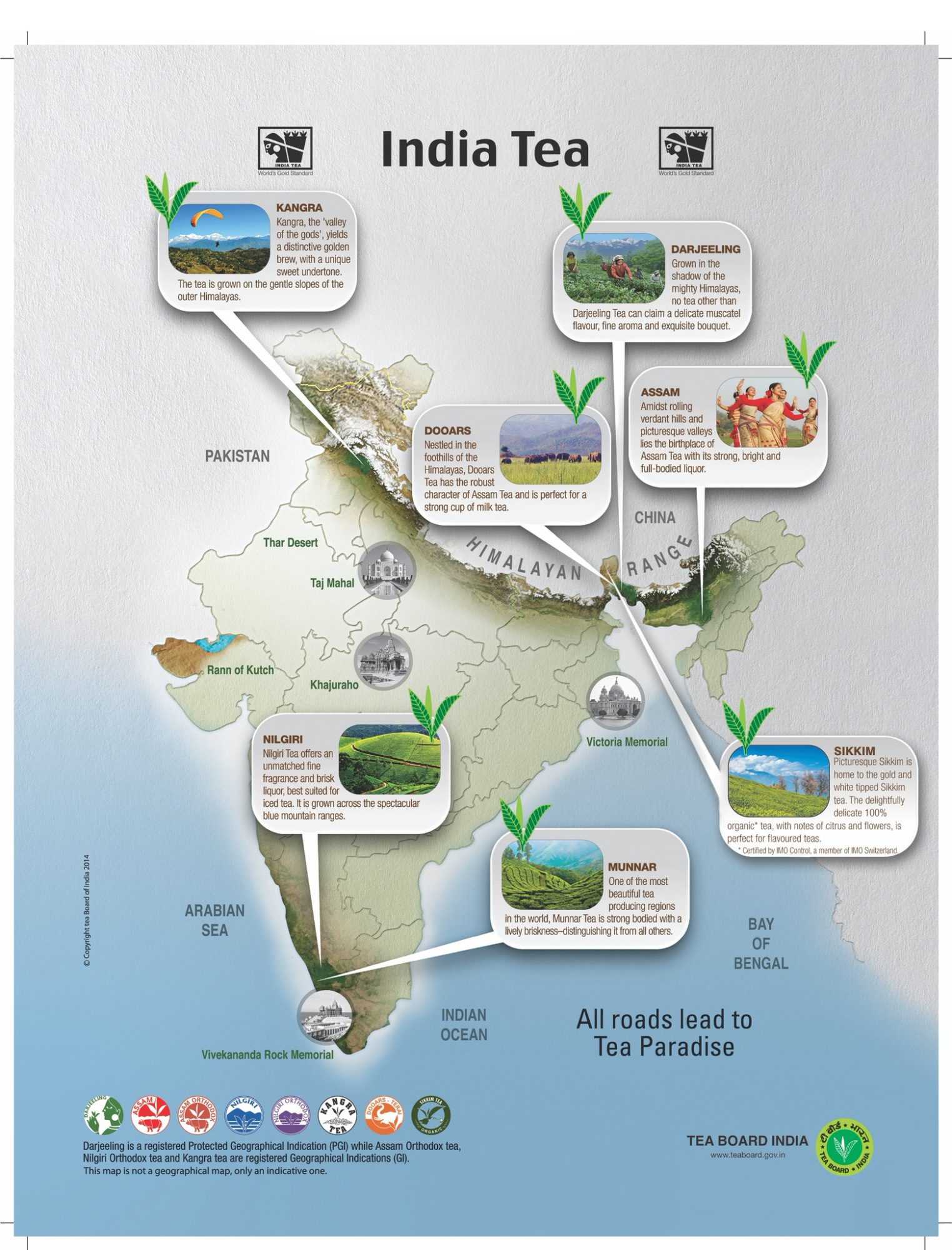
Source: Tea for Me Please — 7 Indian Tea Regions You Should Know - Tea for Me Please · www.teaformeplease.com
Tea Board paradox: Though tea is agricultural, Tea Board is under Commerce (export focus)
Location memory: Tea-Kolkata, Coffee-Bengaluru, Spices-Kochi, Rubber-Kottayam
Ministry confusion: Don't assume agricultural commodities = Agriculture Ministry
Indian Tea Industry
Indian Economy Tea Board Dubai Moscow
Indian Tea Industry: Production, Exports & Global Presence
India is 2nd largest tea producer globally (after China)
Major varieties: Darjeeling, Assam, Nilgiri, Kangra
Top export destinations: Russia, UAE, Iran, UK
Global Standing
India produces over 1.3 billion kg of tea annually, making it the world's second-largest producer. The industry employs over 1 million people and contributes significantly to export earnings.
Tea Regions & Varieties
# Indian Tea Varieties
## **Assam Tea**
- Strong malty flavor
- CTC processing
- Largest production
- Plains cultivation
## **Darjeeling Tea**
- Muscatel flavor
- Orthodox processing
- High altitude
- GI tag protection
## **Nilgiri Tea**
- Citrusy flavor
- South Indian
- Year-round harvest
- Export quality
## **Other Varieties**
- Kangra (Himachal)
- Dooars (West Bengal)
- Terai (Uttarakhand)
Export Profile
Russia - largest importer of Indian tea (Tea Board's Moscow office serves this market)
UAE - major re-export hub for Middle East and Africa (Dubai office strategic)
Iran - traditional market for Indian black tea
Export value - over ₹5,000 crores annually from tea exports
Production ranking: India is 2nd (after China), not 1st in tea production
GI protection: Only Darjeeling has GI tag, not all Indian teas
Overseas offices logic: Dubai (Middle East hub) and Moscow (largest buyer) - strategic locations