The ‘Swadeshi’ and ‘Boycott’ were adopted as methods of struggle for the first time during the
Contents19
- Aagitation against the Partition of Bengal
- BHome Rule Movement
- CNon-Cooperation Movement
- Dvisit of the Simon Commission to India
Show answer
Answer: (A) agitation against the Partition of Bengal
Answer: (a) Agitation against the Partition of Bengal
Swadeshi ('buy Indian') and Boycott ('reject British goods') were first adopted during the anti-Partition of Bengal agitation in 1905.
Lord Curzon's partition was seen as 'divide and rule.'
Indians responded by burning British cloth and promoting Indian-made goods.
Why not others?
(b) Home Rule Movement (1916) - Came later.
(c) Non-Cooperation Movement (1920-22) - Used different primary methods under Gandhi.
(d) Simon Commission visit (1928) - Protest was 'Simon Go Back'; Swadeshi/Boycott had been used much earlier.
Source: NCERT Class XII, Bipan Chandra.
The 1905 Partition of Bengal marked the first systematic use of economic nationalism as a political weapon in India's independence struggle.
Swadeshi and Boycott became the template for later mass movements - Gandhi adapted these methods during Non-Cooperation in 1920-22.
The question tests chronology of resistance methods, distinguishing between the original 1905 Bengal agitation and later movements that refined these tactics.
Partition of Bengal (1905)
Modern Indian History Partition of Bengal
Partition of Bengal (1905): Curzon's Divide & Rule Policy
Lord Curzon partitioned Bengal on October 16, 1905 ostensibly for administrative efficiency
Created East Bengal & Assam (Muslim majority) and West Bengal (Hindu majority)
Real motive was divide and rule - weaken Bengali nationalism by communal division
Sparked the first mass nationalist movement using Swadeshi and Boycott
Background
Bengal Presidency was the largest province with 78 million people. Lord Curzon claimed it was too large to administer effectively, but the real goal was to break Bengali unity and create Hindu-Muslim division.
Partition Details
New Province | Capital | Population | Composition |
|---|---|---|---|
East Bengal & Assam | Dacca | 31 million | 18 million Muslims, 12 million Hindus |
West Bengal | Calcutta | 54 million | 42 million Hindus, 9 million Muslims |
Partition Map
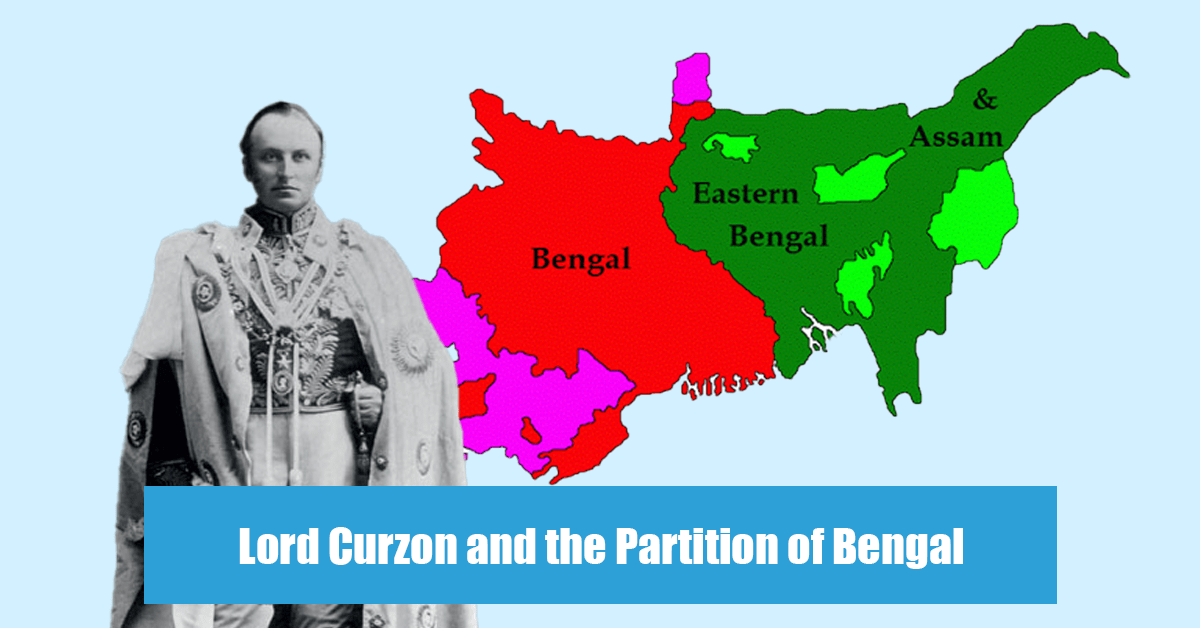
Source: x.com — Today-in-History (Oct 16): In 1905, Lord Curzon, the Viceroy ... · x.com
Impact & Consequences
Sparked the Anti-Partition Movement - first mass political agitation in India
Led to emergence of militant nationalism alongside moderate Congress methods
Rabindranath Tagore composed 'Amar Shonar Bangla' as protest song
Partition was annulled in 1911 due to sustained resistance
Capital shifted from Calcutta to Delhi in 1911 as compensation to British interests
Trap: Don't confuse with 1947 Bengal Partition - that was permanent, this was annulled in 1911
Trap: Swadeshi-Boycott started here in 1905, not during later movements like Non-Cooperation
Trap: Partition was administrative excuse - real motive was divide and rule
Trap: East Bengal had Muslim majority, West Bengal had Hindu majority - don't reverse this
Swadeshi & Boycott Movement
Modern Indian History Swadeshi Boycott
Swadeshi & Boycott Movement: First Economic Nationalism (1905)
Swadeshi (buy Indian) and Boycott (reject British goods) first used in 1905 against Bengal Partition
Combined economic resistance with political protest - new method in Indian nationalism
Led by Bal Gangadhar Tilak, Bipin Chandra Pal, and Lala Lajpat Rai
Promoted indigenous industries and national education as alternatives
Swadeshi vs Boycott
Method | Meaning | Action | Goal |
|---|---|---|---|
Swadeshi | Buy Indian | Promote indigenous goods | Economic self-reliance |
Boycott | Reject British | Refuse foreign products | Hit British economic interests |
Key Activities
Bonfire of British cloth - public burning of Manchester textiles
Swadeshi stores opened to sell Indian-made goods exclusively
National education - Bengal Technical Institute, Jadavpur founded
Rakhi Bandhan celebrated as symbol of Bengal unity
Cultural nationalism - revival of Bengali literature, art, and festivals
Movement Progression
%%{init: {"flowchart": {"wrappingWidth": 460}}}%%
flowchart TD
  s1["`**Partition Announced (1905)**
Curzon announces Bengal division`"]
  s2["`**Initial Protests**
Petitions, meetings, moderate opposition`"]
  s3["`**Swadeshi-Boycott Launch**
Economic methods adopted for first time`"]
  s4["`**Mass Participation**
Students, women, traders join movement`"]
  s5["`**Government Repression**
Arrests, deportations, violent suppression`"]
  s6["`**Partition Annulled (1911)**
Movement achieves primary goal`"]
  s1 --> s2
  s2 --> s3
  s3 --> s4
  s4 --> s5
  s5 --> s6
Question Connection
This PYQ tests when Swadeshi and Boycott were FIRST used. The answer is 1905 Anti-Partition agitation - these methods were later adopted in Home Rule, Non-Cooperation, but originated here.
Trap: First use was 1905, not in later movements like Non-Cooperation (1920) or Home Rule (1916)
Trap: Swadeshi = constructive (promote Indian goods), Boycott = destructive (reject British goods)
Trap: Don't confuse with Gandhi's methods - this was pre-Gandhian economic nationalism
Trap: Anti-Partition movement was successful - partition was annulled in 1911
Home Rule Movement (1916)
Modern Indian History Home Rule Movement
Home Rule Movement (1916): Demand for Self-Government
Home Rule Movement started in 1916 by Annie Besant and Bal Gangadhar Tilak
Demanded self-government for India within the British Empire, not independence
Used constitutional methods - propaganda, petitions, public meetings
Came 11 years after Swadeshi-Boycott movement
Two Home Rule Leagues
Leader | Founded | Base | Area of Operation |
|---|---|---|---|
Annie Besant | September 1916 | Madras | Madras, Bombay, Central Provinces, UP |
Bal Gangadhar Tilak | April 1916 | Poona | Maharashtra, Karnataka, Central Provinces, Berar |
Methods & Characteristics
Constitutional agitation - no economic boycott like 1905 movement
Propaganda through newspapers - 'New India' by Besant, 'Maratha' by Tilak
Public meetings and lectures across the country
Mass membership - both leagues had thousands of members
Government repression - Besant interned in 1917, Tilak prosecuted
Trap: Home Rule used constitutional methods, not Swadeshi-Boycott economic resistance
Trap: Started in 1916, much later than 1905 Anti-Partition movement
Trap: Demanded self-government, not complete independence like later movements
Non-Cooperation Movement (1920-22)
Modern Indian History Non-Cooperation Movement
Non-Cooperation Movement (1920-22): Gandhi's First Mass Movement
Non-Cooperation Movement launched by Gandhi in 1920 after Jallianwala Bagh and Khilafat issue
Used Gandhian methods - ahimsa, satyagraha, non-violence as core principle
Suspended in 1922 after Chauri Chaura incident due to violence
Did include Swadeshi, but as part of broader non-cooperation, not as the primary method
Primary Methods
Boycott of government institutions - courts, schools, legislatures
Resignation from titles and honors - surrender of knighthoods, etc.
Non-payment of taxes in select areas
Boycott of foreign cloth - revival of Swadeshi, but within non-cooperation framework
Constructive program - khadi, spinning wheel, village industries
Movement Timeline
%%{init: {"flowchart": {"wrappingWidth": 460}}}%%
flowchart TD
  s1["`**Triggers (1919-20)**
Jallianwala Bagh, Rowlatt Act, Khilafat issue`"]
  s2["`**Launch (August 1920)**
Gandhi announces Non-Cooperation at Calcutta Congress`"]
  s3["`**Mass Participation (1920-21)**
Students, lawyers, peasants join movement`"]
  s4["`**Chauri Chaura (February 1922)**
Violence breaks out, 22 policemen killed`"]
  s5["`**Suspension (February 1922)**
Gandhi suspends movement due to violence`"]
  s1 --> s2
  s2 --> s3
  s3 --> s4
s4 --> s5Trap: Non-Cooperation included Swadeshi but wasn't primarily about it - focused on institutional boycott
Trap: Started in 1920, not 1905 - Swadeshi-Boycott were first used 15 years earlier
Trap: Suspended due to violence at Chauri Chaura - Gandhi's commitment to non-violence
Trap: Combined with Khilafat Movement - Hindu-Muslim unity was key feature
Simon Commission Protest (1928)
Modern Indian History Simon Commission
Simon Commission Protest (1928): 'Simon Go Back' Movement
Simon Commission arrived in 1928 to review Government of India Act 1919
All-white commission with no Indian members sparked nationwide boycott
Protest slogan was 'Simon Go Back', not Swadeshi-Boycott methods
Lala Lajpat Rai died from injuries during Simon Commission protests in Lahore
Simon Commission vs Earlier Movements
Movement | Year | Primary Method | Target |
|---|---|---|---|
Anti-Partition | 1905 | Swadeshi-Boycott | British goods, Bengal division |
Home Rule | 1916 | Constitutional agitation | Self-government demand |
Non-Cooperation | 1920-22 | Institutional boycott | Government cooperation |
Simon Commission | 1928 | 'Simon Go Back' slogan | All-white commission |
Protest Methods
Black flag demonstrations wherever Simon Commission went
Hartals and strikes in major cities
'Simon Go Back' slogans - different from economic boycott methods
All-party boycott - Congress, Muslim League, Hindu Mahasabha united
Lathi charge in Lahore led to Lala Lajpat Rai's death
Trap: Simon Commission protests used 'Simon Go Back' slogan, not Swadeshi-Boycott economic methods
Trap: Happened in 1928, much later than 1905 first use of Swadeshi-Boycott
Trap: Was about constitutional representation, not economic nationalism
Trap: All-party boycott showed rare Hindu-Muslim unity against commission