Consider the following pairs:
Contents15
Consider the following pairs:
| Craft | Heritage of | |
|---|---|---|
| 1. | Puthukkuli shawls | Tamil Nadu |
| 2. | Sujni embroidery | Maharashtra |
| 3. | Uppada Jamdani saris | Karnataka |
Which of the pairs given above is/are correct?
- A1 only
- B1 and 2
- C3 only
- D2 and 3
Show answer
Answer: (A) 1 only
Correct Answer: (a) 1 only
Puthukkuli shawls — Tamil Nadu: CORRECT. These shawls are made by the Toda tribe of Tamil Nadu (Nilgiri Hills). They do intricate embroidery called 'Pithukuli' on cream-coloured shawls using red and black threads. The shawl is reversible (can be used from both sides).
Sujni embroidery — Maharashtra: WRONG. Sujni (also called Sujini) embroidery is from BIHAR, not Maharashtra. It originates from the Bhusura village of Muzaffarpur district in Bihar. It uses running stitches to create narrative designs on quilts.
Uppada Jamdani saris — Karnataka: WRONG. Uppada Jamdani saris are from ANDHRA PRADESH, not Karnataka. They are woven in Uppada, a small town in the East Godavari district of Andhra Pradesh. The Jamdani technique involves weaving patterns directly into the fabric.
REMEMBER:
- Puthukkuli shawls = Toda tribe = Tamil Nadu (correct).
- Sujni embroidery = Bihar (not Maharashtra).
- Uppada Jamdani = Andhra Pradesh (not Karnataka).
These craft-state matching questions are common in UPSC — memorize unusual pairs.
Indian handicrafts got GI (Geographical Indication) tags around 2016-2018, making craft-state matching questions popular in UPSC during this period.
UPSC uses tribal crafts like Puthukkuli (Toda tribe) and regional embroidery like Sujni (Bihar) to test whether students can distinguish between similar-sounding crafts from different states.
Puthukkuli Shawls & Toda Tribe
Art And Culture Puthukkuli shawls Tamil Nadu
Puthukkuli Shawls: Toda Tribe's Reversible Embroidery of Tamil Nadu
Puthukkuli shawls are made by the Toda tribe of Tamil Nadu (Nilgiri Hills)
Features reversible embroidery using red and black threads on cream-coloured fabric
Uses intricate Pithukuli embroidery technique with traditional geometric patterns
What Makes Them Unique
Puthukkuli shawls are the signature handicraft of the Toda tribe, indigenous people living in the Nilgiri Hills of Tamil Nadu. The name comes from their distinctive embroidery technique called Pithukuli, which creates intricate geometric patterns that are perfectly reversible — the shawl can be worn from either side with equal beauty.
Key Features
Made on cream-coloured woollen fabric as the base material
Embroidered with red and black threads in traditional geometric designs
Reversible quality — both sides show identical patterns and can be used
Created by Toda women using techniques passed down through generations
Patterns often represent buffalo motifs and geometric symbols significant to Toda culture
Visual Recognition

Source: Pinterest — Toda Shawls known as 'puthukulli' made by the Toda tribe in the ... · in.pinterest.com
Trap: UPSC may pair Puthukkuli with Kerala or Karnataka — remember it's Tamil Nadu (Nilgiri Hills)
Confusion: Don't mix with Pochampally (Telangana) or Paithani (Maharashtra) — Puthukkuli is specifically Toda tribal craft
Memory aid: Puth-u-kkuli = Tamil Nadu — both have 'u' sounds, and Todas are hill tribe of Tamil Nadu
Sujni Embroidery of Bihar
Art And Culture Sujni embroidery Maharashtra
Sujni Embroidery: Bihar's Narrative Quilting Tradition
Sujni embroidery originates from Bihar, specifically Bhusura village in Muzaffarpur district
Uses running stitches to create narrative designs on quilts and fabrics
Features storytelling motifs depicting daily life, mythology, and folk tales
Origin & Technique
Sujni (also spelled Sujini) is a traditional embroidery art from Bihar, particularly from Bhusura village in Muzaffarpur district. The technique uses simple running stitches to create elaborate narrative scenes on quilts, telling stories through thread and fabric.
Distinctive Features
Running stitch technique — simple forward stitches create complex patterns
Narrative themes — depicts daily life, festivals, mythology, and folk tales
Bright coloured threads on cotton or silk base fabric
Recycled materials — traditionally uses old saris and cloth pieces
Women's craft — practiced by rural women as both art and income source
Visual Style
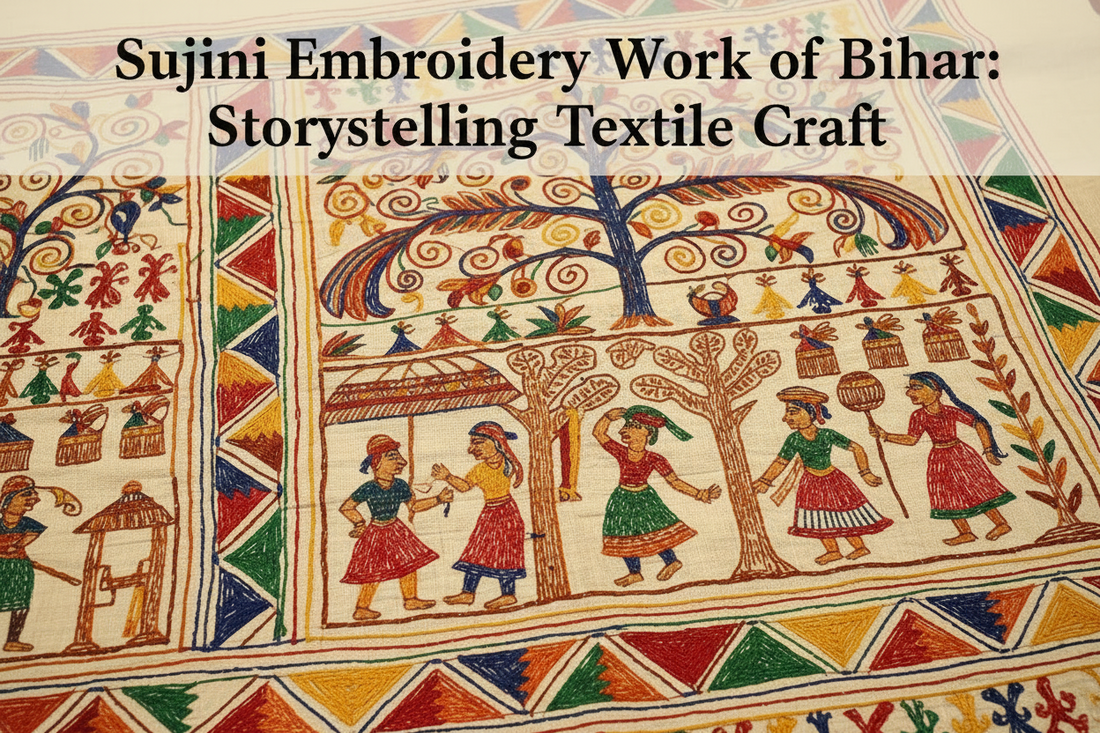
Source: Krafteria — Sujini Embroidery Work of Bihar: Storytelling Textile Craft ... · krafteria.com
Major trap: Question pairs Sujni with Maharashtra — it's actually Bihar (Muzaffarpur district)
Don't confuse with: Warli art (Maharashtra) or Madhubani (also Bihar but different technique)
Remember: Sujni = Bihar, uses running stitches for narrative quilts
Uppada Jamdani Saris
Art And Culture Uppada Jamdani saris Karnataka
Uppada Jamdani: Andhra Pradesh's Woven Poetry
Uppada Jamdani saris are woven in Uppada town, East Godavari district, Andhra Pradesh
Uses traditional Jamdani technique — patterns woven directly into the fabric during weaving
Known for lightweight silk with intricate floral and geometric motifs
Origin & Craft
Uppada Jamdani saris are handwoven in Uppada, a small coastal town in East Godavari district of Andhra Pradesh. The Jamdani technique involves weaving patterns directly into the fabric during the weaving process, creating a lightweight, almost transparent silk sari with exquisite motifs.
Weaving Characteristics
Jamdani technique — patterns created by adding extra weft threads during weaving
Lightweight silk fabric — almost transparent quality with fine texture
Floral and geometric motifs — traditional designs woven into the fabric
Time-intensive process — can take weeks to complete one sari
Coastal influence — designs often reflect maritime and nature themes
Weaving Process

Source: Mint — Next-Gen Weavers: Jamdani of the south · www.livemint.com
Critical trap: Question links Uppada Jamdani with Karnataka — it's actually Andhra Pradesh (East Godavari)
Location confusion: Uppada sounds similar to Udupi (Karnataka) — don't get misled
Remember: Uppada = Andhra Pradesh, Jamdani = woven patterns, not printed or embroidered
Indian Handicrafts State Mapping
Art And Culture
State-wise Handicraft Mapping: UPSC's Favorite Testing Pattern
UPSC frequently tests craft-state pairings with deliberate wrong associations as traps
Focus on unique regional crafts and their specific districts/towns of origin
Learn tribal handicrafts separately as they have distinct geographical clusters
High-Frequency Craft-State Pairs
Craft | Correct State | Common Trap States | Key Identifier |
|---|---|---|---|
Puthukkuli shawls | Tamil Nadu | Kerala, Karnataka | Toda tribe, Nilgiri Hills |
Sujni embroidery | Bihar | Maharashtra, West Bengal | Muzaffarpur, running stitch |
Uppada Jamdani | Andhra Pradesh | Karnataka, Tamil Nadu | East Godavari, woven patterns |
Pochampally | Telangana | Andhra Pradesh | Ikat technique, geometric patterns |
Paithani saris | Maharashtra | Madhya Pradesh | Aurangabad, peacock motifs |
Madhubani painting | Bihar | Jharkhand, West Bengal | Mithila region, wall art |
Memory Strategies
Link crafts to tribes — Puthukkuli (Toda), Warli (Maharashtra tribal art)
Remember districts — Uppada (East Godavari), Sujni (Muzaffarpur), Pochampally (Nalgonda)
Group by technique — Jamdani (woven), Sujni (embroidered), Madhubani (painted)
Coastal vs inland — Uppada (coastal AP), Pochampally (inland Telangana)
Sound associations — Puthukkuli has 'u' sounds like Tamil
Pattern: UPSC pairs crafts with neighboring states or similar-sounding places
Tribal confusion: Don't assume all tribal crafts are from Northeast — Todas are in Tamil Nadu
State bifurcation: Post-2014, distinguish Telangana crafts from Andhra Pradesh crafts
Technique vs origin: Jamdani technique exists in multiple states — Uppada is the AP variant