In which of the following States is lion-tailed macaque found in its natural habitat? 1. Tamil Nadu 2. Kerala 3. Karnataka 4. Andhra Pradesh Select the correct answer using the codes given below:
Contents11
- A1, 2 and 3 only
- B2 only
- C1, 3 and 4 only
- D1, 2, 3 and 4
Show answer
Answer: (A) 1, 2 and 3 only
The lion-tailed macaque (Macaca silenus) is one of the most endangered primates in the world.
It is a habitat specialist — confined in distribution to the rainforests of the southern Western Ghats.
It has adapted specifically to the evergreen forests available in three south Indian states:
Kerala (1) — found in Silent Valley National Park, Periyar, and other Western Ghats forests.
Tamil Nadu (2) — found in the Anamalai Hills, Nilgiris, and adjoining forest areas.
Karnataka (3) — found in parts of the Western Ghats in Karnataka.
Andhra Pradesh (4) — NOT in the natural range.
The lion-tailed macaque's habitat does not extend to Andhra Pradesh, which lies on the eastern/drier side of the peninsula, away from the wet evergreen forests of the Western Ghats.
It was in the news when it was taken off the 'Top 25 most endangered primates' list due to conservation efforts, though it remains vulnerable.
Lion-tailed macaque is one of the world's most endangered primates, found only in the rainforests of the southern Western Ghats across Kerala, Tamil Nadu, and Karnataka.
The species was removed from the 'Top 25 most endangered primates' list around 2012-2013 due to conservation efforts, making it a relevant current affairs topic for the 2013 exam.
UPSC is testing precise knowledge of endemic species distribution in the Western Ghats versus the drier eastern regions like Andhra Pradesh.
Lion-tailed Macaque: Distribution & Habitat
Environment lion-tailed macaque Tamil Nadu Kerala Karnataka Andhra Pradesh
Lion-tailed Macaque: Habitat Specialist of Western Ghats
Found only in Tamil Nadu, Kerala, and Karnataka — confined to Western Ghats rainforests
NOT found in Andhra Pradesh — habitat doesn't extend to eastern/drier regions
Habitat specialist adapted to evergreen forests only
Macaca silenus — one of world's most endangered primates
The lion-tailed macaque (Macaca silenus) is a habitat specialist — meaning it can survive only in very specific environmental conditions. It is confined entirely to the rainforests of the southern Western Ghats, making it one of India's most geographically restricted primates.
State-wise Distribution
State | Present | Key Protected Areas | Habitat Type |
|---|---|---|---|
Kerala | ✓ | Silent Valley NP, Periyar Tiger Reserve | Evergreen rainforests |
Tamil Nadu | ✓ | Anamalai Hills, Nilgiris | Western Ghats forests |
Karnataka | ✓ | Western Ghats region | Wet evergreen forests |
Andhra Pradesh | ✗ | None | Eastern/drier regions — unsuitable habitat |
Western Ghats Distribution

Source: Mongabay-India — Vanishing forests drive lion-tailed macaques to search for food in people's homes · india.mongabay.com
Habitat Requirements
Evergreen rainforests only — cannot adapt to deciduous or dry forests
High rainfall areas — Western Ghats receive heavy monsoon precipitation
Canopy-dependent — spends most time in upper tree layers
Altitude preference — typically found at 500-1500m elevation
Fragmented populations — habitat loss has created isolated pockets
The key trap in this question is Andhra Pradesh — many students assume it's included because it's a southern state. However, Andhra Pradesh lies on the eastern side of the peninsula, away from the wet Western Ghats where lion-tailed macaques require evergreen rainforest habitat.
Andhra Pradesh trap: Located on eastern/drier side — lion-tailed macaque needs Western Ghats rainforests only
Don't confuse with Nilgiri langur or other Western Ghats primates — each has specific distribution
Habitat specialist means very restricted range — not found in all forested areas of South India
Western vs Eastern Ghats: Lion-tailed macaque is Western Ghats endemic — Eastern Ghats too dry
Western Ghats: Endemic Species Hotspot
Environment Western Ghats
Western Ghats: Why It's a Global Biodiversity Hotspot
One of 36 global biodiversity hotspots — exceptionally high endemism
Spans 6 states: Kerala, Tamil Nadu, Karnataka, Goa, Maharashtra, Gujarat
UNESCO World Heritage Site since 2012
Over 5000 flowering plants, 40% endemic to the region
The Western Ghats mountain range runs parallel to India's western coast for about 1600 km. Its unique geography creates a rain shadow effect — the western slopes receive heavy monsoon rainfall, creating lush evergreen forests, while the eastern slopes remain relatively dry.
Western Ghats vs Eastern Ghats
Feature | Western Ghats | Eastern Ghats |
|---|---|---|
Rainfall | Heavy (2000-8000mm annually) | Moderate (600-1200mm) |
Forest Type | Evergreen, semi-evergreen | Dry deciduous, scrubland |
Endemism | Very high (many species) | Lower |
Primate Species | Lion-tailed macaque, Nilgiri langur | Very few endemic primates |
Biodiversity Status | Global hotspot | Not classified as hotspot |
Endemic Species Categories
# Western Ghats Endemics
## Mammals
- Lion-tailed macaque
- Nilgiri tahr
- Malabar civet
- Nilgiri langur
## Birds
- Malabar grey hornbill
- Nilgiri flycatcher
- Kerala laughingthrush
## Amphibians
- Malabar gliding frog
- Purple frog
- Various caecilians
## Plants
- Neelakurinji
- Myristica swamps
- Shola grasslandsDon't confuse Western and Eastern Ghats — Western has high rainfall and endemism, Eastern is drier
All 6 states matter: Western Ghats extends beyond just Kerala-Tamil Nadu-Karnataka into Maharashtra, Goa, Gujarat
Rain shadow effect: Western slopes get rain, eastern slopes are dry — explains habitat distribution
Hotspot definition: High endemism + habitat loss threat — not just high biodiversity
Endangered Primates of India
Environment
India's Endangered Primates: Conservation Status & Threats
India has 15+ primate species — several critically endangered
Lion-tailed macaque most endangered — habitat loss primary threat
Western Ghats and Northeast India are primate diversity centers
Habitat fragmentation biggest threat — not hunting
Major Endangered Primates
Species | IUCN Status | Distribution | Key Threat | Population |
|---|---|---|---|---|
Lion-tailed macaque | Endangered | Western Ghats (3 states) | Habitat loss | ~4000 |
Hoolock gibbon | Endangered | Northeast India | Deforestation | ~200 in India |
Nilgiri langur | Vulnerable | Western Ghats | Habitat fragmentation | Unknown |
Golden langur | Endangered | Assam-Bhutan border | Habitat loss | ~6000 |
Slow loris | Vulnerable | Northeast India | Illegal trade | Unknown |
Conservation Challenges
Habitat specialists — unlike generalist monkeys, cannot adapt to modified habitats
Forest fragmentation — roads and development break continuous forest cover
Human-primate conflict — crop raiding leads to persecution in some areas
Climate change — altering forest composition and fruit availability
Limited breeding programs — difficult to maintain in captivity
Primate Conservation
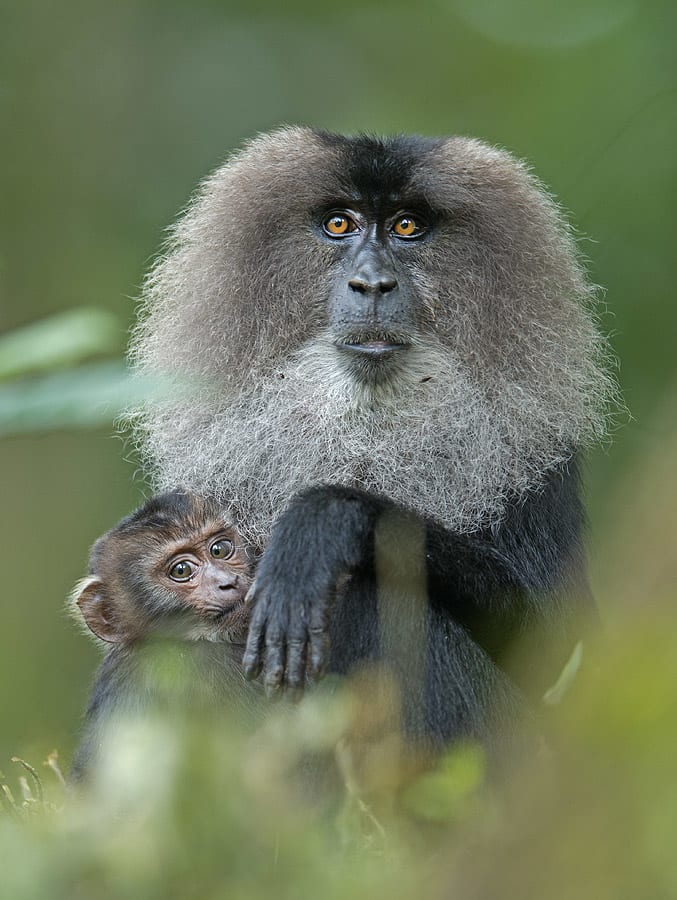
Source: Roundglass Sustain — Pride of the Western Ghats: The Elusive Lion-tailed Macaque · roundglasssustain.com
Don't confuse primate ranges — Hoolock gibbon is Northeast, Lion-tailed macaque is Western Ghats
Endangered vs Critically Endangered — Lion-tailed macaque is Endangered, not Critical
Population recovery — Was in 'Top 25 most endangered' but removed due to conservation success
Habitat type matters — Each primate has specific forest requirements