Which of the following organisms perform waggle dance for others of their kin to indicate the direction and the distance to a source of their food?
Contents11
- AButterflies
- BDragonflies
- CHoneybees
- DWasps
Show answer
Answer: (C) Honeybees
Honey bees perform the waggle dance to tell other bees the direction and distance of a food source.
The direction of the dance relative to the hive indicates direction (relative to the Sun), and the duration of the waggle indicates distance.
This was decoded by Karl von Frisch.
Answer is (c) Honey bees.
The waggle dance is a unique form of symbolic communication found only in honeybees, allowing them to convey precise location information about food sources up to several kilometers away.
Karl von Frisch won the Nobel Prize in 1973 for decoding this bee communication system, making it one of the most famous examples of animal communication studied in behavioral ecology.
Honeybee Waggle Dance Communication
Environment waggle dance honeybees direction distance food source
Honeybee Waggle Dance: Navigation & Communication System
Honeybees perform waggle dance to communicate food source location to nestmates
Dance direction indicates direction relative to Sun, duration indicates distance
Discovered and decoded by Karl von Frisch (Nobel Prize winner)
Part of complex eusocial behavior in honeybee colonies
The waggle dance is a sophisticated communication system unique to honeybees that allows forager bees to share precise location information about food sources with their colony members.
Waggle Dance Components
Dance Element | Information Conveyed | How It Works | Precision |
|---|---|---|---|
Angle of dance | Direction to food source | Angle relative to vertical = angle relative to Sun's position | Accurate to 3 degrees |
Duration of waggle run | Distance to food source | Longer waggle = greater distance | 1 second = ~1000 meters |
Vigor/intensity | Quality of food source | More vigorous dance = higher nectar concentration | Recruits more foragers |
Sound vibrations | Additional distance cues | Wing vibrations during waggle run | Reinforces distance information |
How Waggle Dance Works
%%{init: {"flowchart": {"wrappingWidth": 460}}}%%
flowchart TD
  s1["`**Forager bee discovers food source**
Scout bee finds nectar/pollen rich flowers`"]
  s2["`**Returns to hive with samples**
Brings back nectar sample for other bees to taste`"]
  s3["`**Performs waggle dance on honeycomb**
Dances in figure-8 pattern with waggle run in center`"]
  s4["`**Recruits follow and learn location**
Other bees touch antennae, sample nectar, memorize dance`"]
  s5["`**Recruited bees fly to food source**
Use sun compass and distance info to locate flowers`"]
  s1 --> s2
  s2 --> s3
  s3 --> s4
  s4 --> s5
Karl von Frisch Discovery
Karl von Frisch decoded the waggle dance in the 1960s through systematic observation
Won Nobel Prize in Physiology (1973) for discoveries in animal behavior patterns
Proved that insects have complex communication abilities, challenging previous assumptions
His work established the field of behavioral ecology and animal communication studies
Waggle Dance Pattern
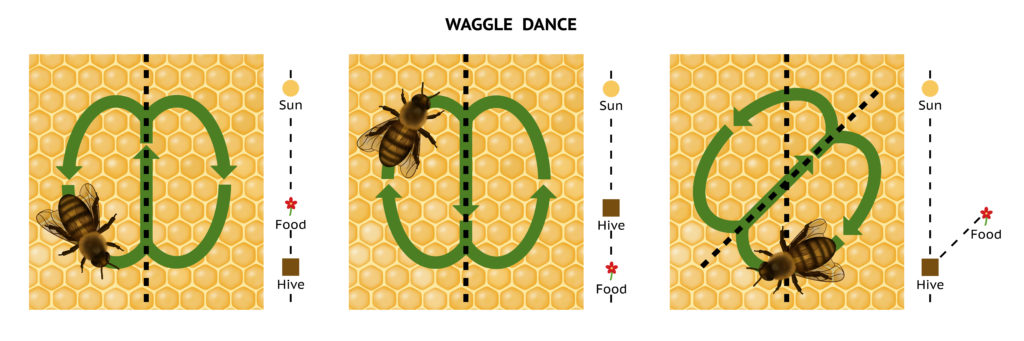
Source: Science Sparks — Do the Waggle Dance - Bee Facts for Kids · www.science-sparks.com
Only honeybees perform waggle dance - wasps, butterflies, dragonflies do not have this behavior
Dance indicates direction relative to Sun, not magnetic north or hive orientation
Duration indicates distance, not the angle or intensity of waggle
This is learned communication, not instinctive flight patterns
Communication in Social Insects
Environment butterflies dragonflies wasps
Communication Methods in Social Insects: Beyond Honeybees
Pheromones are primary communication method in most social insects
Ants use chemical trails, termites use alarm pheromones
Butterflies, dragonflies lack complex social communication systems
Only honeybees use spatial dance communication
While honeybees use waggle dance, other insects rely primarily on chemical communication through pheromones for colony coordination and information sharing.
Communication Methods by Insect Type
Insect | Primary Communication | Social Structure | Information Shared |
|---|---|---|---|
Honeybees | Waggle dance + pheromones | Highly eusocial | Location, distance, quality of food |
Ants | Chemical trails (pheromones) | Highly eusocial | Food trails, danger signals, nest recognition |
Wasps | Pheromones + limited visual cues | Semi-social to eusocial | Alarm signals, nest defense |
Termites | Alarm pheromones + vibrations | Highly eusocial | Danger warnings, caste recognition |
Butterflies | Chemical + visual (mating only) | Solitary | Mate recognition, territory |
Dragonflies | Visual displays (mating only) | Solitary | Territory defense, mate selection |
Why Others Don't Waggle Dance
Butterflies and dragonflies are largely solitary - no complex colony coordination needed
Ants use persistent chemical trails that work better than temporary dances
Wasps have smaller colonies with less specialized foraging compared to honeybees
Termites focus on nest defense and construction, not distant foraging coordination
Don't assume all social insects use waggle dance - it's honeybee-specific
Wasps may seem similar to honeybees but lack complex spatial communication
Chemical communication is far more common than dance communication in insects
Types of Animal Communication
Environment
Animal Communication: Modalities & Functions in Nature
Animals use chemical, visual, auditory, tactile communication modalities
Chemical (pheromones) is most widespread across species
Spatial/location communication is rare - mainly honeybees and some birds
Communication complexity increases with social organization level
Communication Modalities
# Animal Communication
## Chemical
- Pheromones (insects)
- Scent marking (mammals)
- Chemical trails (ants)
- Alarm substances
## Visual
- Displays (peacocks)
- Color changes (chameleons)
- Bioluminescence (fireflies)
- Dance (honeybees)
## Auditory
- Bird songs
- Whale calls
- Frog calls
- Insect stridulation
## Tactile
- Grooming (primates)
- Vibrations (spiders)
- Electric fields (fish)
- Touch rituals
Examples by Communication Function
Function | Chemical | Visual | Auditory | Spatial/Dance |
|---|---|---|---|---|
Food location | Ant trails | Bee colors on flowers | Bird alarm calls | Honeybee waggle dance |
Mating | Moth sex pheromones | Peacock displays | Frog mating calls | Bird courtship flights |
Territory | Mammal scent marking | Fish color displays | Bird territorial songs | Rare |
Danger | Alarm pheromones | Warning coloration | Alarm calls | None known |
The waggle dance represents one of the most sophisticated examples of symbolic communication in non-human animals, where abstract information (direction, distance) is encoded in movement patterns.
UPSC Connection: This question tested knowledge that spatial communication through dance is unique to honeybees among the given options.