Consider the following statements: 1. Deification of the Buddha 2. Trading the path of Bodhisattvas 3. Image worship and rituals Which of the above is/are the feature/features of Mahayana Buddhism?
Contents13
- A1 only
- B1 and 2 only
- C2 and 3 only
- D1, 2 and 3
Show answer
Answer: (D) 1, 2 and 3
The correct answer is (D) — 1, 2 and 3.
All three are features of Mahayana Buddhism, which emerged around the 1st century AD.
Deification of the Buddha (statement 1) — Mahayana started worshipping Buddha as a god, unlike earlier traditions that saw him as a teacher.
The Bodhisattva path (statement 2) — Mahayana emphasizes becoming a Bodhisattva (one who delays their own nirvana to help others achieve it).
Image worship and rituals (statement 3) — Mahayana introduced idol worship of Buddha and Bodhisattvas.
Tip:
- Mahayana = Buddha as God
- Bodhisattva ideal
- Image worship.
Hinayana/Theravada = Buddha as teacher, no idol worship.
Mahayana Buddhism transformed Buddha from a teacher into a deity around the 1st century AD, introducing idol worship and elaborate rituals unlike earlier Buddhist traditions.
The Bodhisattva ideal distinguishes Mahayana from Theravada Buddhism - Bodhisattvas postpone their own salvation to help all beings achieve enlightenment first.
Mahayana Buddhism Features
Ancient And Medieval History Mahayana Buddhism Deification of the Buddha Bodhisattvas Image worship
Mahayana Buddhism: Key Features & UPSC Distinctions
Mahayana Buddhism emerged around 1st century AD with three key features: Buddha deification, Bodhisattva path, and image worship
Deification means Buddha became a god to worship, not just a teacher to follow
Bodhisattva path = postponing one's own nirvana to help others achieve liberation first
Image worship introduced idol worship of Buddha and Bodhisattvas with elaborate rituals
Mahayana Buddhism represents a major evolutionary shift from early Buddhism. While original Buddhism focused on individual liberation through the Buddha's teachings, Mahayana transformed Buddhism into a devotional religion with gods, saviors, and elaborate worship practices.
Three Core Features of Mahayana
Feature | What It Means | Key Change | Example |
|---|---|---|---|
Deification of Buddha | Buddha becomes a divine being to worship | From teacher → god | Buddha statues in temples, prayers to Buddha |
Bodhisattva Path | Ideal of postponing nirvana to help others | From self-liberation → universal salvation | Avalokiteshvara, Manjushri as compassionate saviors |
Image Worship & Rituals | Idol worship with elaborate ceremonies | From meditation → devotional practices | Buddha statues, stupas, ritual offerings |
Why These Changes Occurred
Popular appeal: Made Buddhism accessible to common people who preferred devotion over complex philosophy
Compassionate ideal: Bodhisattva concept emphasized helping others, not just personal enlightenment
Competition with Hinduism: Image worship helped Buddhism compete with Hindu deity worship
Institutional support: Monasteries promoted ritualistic practices for patronage and donations
All three statements are correct — UPSC tests whether students know Mahayana includes ALL these features, not just some
Don't confuse with Hinayana/Theravada — that school rejected deification and image worship, stuck to Buddha as teacher only
Bodhisattva ≠ Buddha — Bodhisattvas are beings who could achieve nirvana but choose to stay back and help others first
Buddhist Schools Comparison
Ancient And Medieval History Mahayana Buddhism
Mahayana vs Hinayana: Core Differences for UPSC
Hinayana/Theravada = original Buddhism; Mahayana = evolved Buddhism with deity worship
Hinayana means 'Lesser Vehicle'; Mahayana means 'Greater Vehicle'
Geographic spread: Hinayana in Sri Lanka, Myanmar, Thailand; Mahayana in China, Japan, Tibet
The Great Schism in Buddhism occurred around the 1st century AD, splitting Buddhism into two major schools with fundamentally different approaches to salvation, worship, and the nature of Buddha himself.
Mahayana vs Hinayana Comparison
Aspect | Hinayana/Theravada | Mahayana |
|---|---|---|
Buddha's Status | Teacher & guide (human who achieved enlightenment) | Divine being to be worshipped (deified) |
Salvation Goal | Individual nirvana (personal liberation) | Universal salvation (Bodhisattva ideal) |
Worship Practice | No idol worship (meditation, following teachings) | Image worship with rituals and ceremonies |
Language | Pali (Buddha's original language) | Sanskrit (more accessible) |
Key Regions | Sri Lanka, Myanmar, Thailand | China, Japan, Tibet, Korea |
Meaning | Lesser Vehicle (fewer people can achieve salvation) | Greater Vehicle (salvation for all) |
UPSC Question Patterns
Feature identification: Questions ask which features belong to which school (like this PYQ)
Geographic distribution: Where each school spread and why
Philosophical differences: Individual vs universal salvation concepts
Historical timeline: When the split occurred and reasons behind it
Don't mix features — Image worship and deification are Mahayana only, not Hinayana
Theravada = Hinayana — Same school, different names (Theravada is preferred modern term)
Bodhisattva concept exists in both but Mahayana emphasizes it as the ideal path while Hinayana focuses on Arhat (individual enlightenment)
Bodhisattva Concept
Ancient And Medieval History Bodhisattvas
Bodhisattva: The Compassionate Ideal of Mahayana Buddhism
Bodhisattva = enlightened being who postpones nirvana to help others achieve liberation
Central to Mahayana Buddhism — represents universal compassion over individual salvation
Famous Bodhisattvas: Avalokiteshvara (compassion), Manjushri (wisdom)
The Bodhisattva ideal revolutionized Buddhism by shifting focus from personal enlightenment to universal salvation. Unlike the Arhat (Hinayana ideal) who seeks individual nirvana, a Bodhisattva vows to remain in the cycle of rebirth until all beings achieve liberation.
The Bodhisattva Path
%%{init: {"flowchart": {"wrappingWidth": 460}}}%%
flowchart TD
  s1["`****Bodhicitta****
Awakening of compassionate mind to help all beings`"]
  s2["`****Ten Perfections****
Practicing virtues like generosity, patience, wisdom`"]
  s3["`****Near Buddhahood****
Achieving enlightenment but ready to become Buddha`"]
  s4["`****Compassionate Choice****
Postponing nirvana to help others achieve liberation first`"]
  s5["`****Eventual Buddhahood****
Becomes Buddha only after helping all beings`"]
  s1 --> s2
  s2 --> s3
  s3 --> s4
  s4 --> s5
Famous Bodhisattvas
Bodhisattva | Quality | Symbolism | Popular In |
|---|---|---|---|
Avalokiteshvara | Compassion | Thousand eyes and arms to see/help suffering | Tibet (Dalai Lama's patron) |
Manjushri | Wisdom | Sword to cut through ignorance | China, Japan |
Maitreya | Future Buddha | Buddha-to-be waiting to descend | All Mahayana regions |
Bodhisattva ≠ Buddha — Bodhisattvas are pre-Buddha beings who chose to delay their own Buddhahood
Mahayana exclusive — While Hinayana mentions Bodhisattvas, only Mahayana makes it the central ideal
Not just compassion — Bodhisattva path requires wisdom + compassion together, not just kindness
Buddhist Image Worship Evolution
Ancient And Medieval History Image worship rituals
Buddhist Image Worship: From Symbols to Statues
Early Buddhism had no Buddha statues — used symbols like footprints, wheels, stupas
Mahayana Buddhism introduced Buddha statues and Bodhisattva images for worship
Gandhara and Mathura schools (1st-2nd century AD) created first Buddha images
Early Buddhism avoided depicting Buddha in human form out of reverence. The transformation to image worship marked Buddhism's evolution from a philosophical system to a devotional religion with elaborate rituals and temple practices.
Evolution of Buddhist Worship
Period | Worship Style | Symbols/Images | Key Change |
|---|---|---|---|
Early Buddhism (6th-1st century BC) | Symbolic worship | Footprints, Wheel, Tree, Stupa | Buddha's presence indicated, not shown |
Transitional Period (1st century BC-AD) | Growing devotion | Elaborate stupas, relics | Preparation for image worship |
Mahayana Period (1st century AD onwards) | Image worship | Buddha statues, Bodhisattva images | Direct worship of divine Buddha |
Why Image Worship Developed
Popular demand: Common people found abstract symbols difficult to relate to emotionally
Greek influence: Gandhara art combined Greek sculptural techniques with Buddhist themes
Competition: Hindu bhakti traditions made devotional worship appealing
Institutional needs: Monasteries needed focal points for community worship and donations
Buddha Image Styles
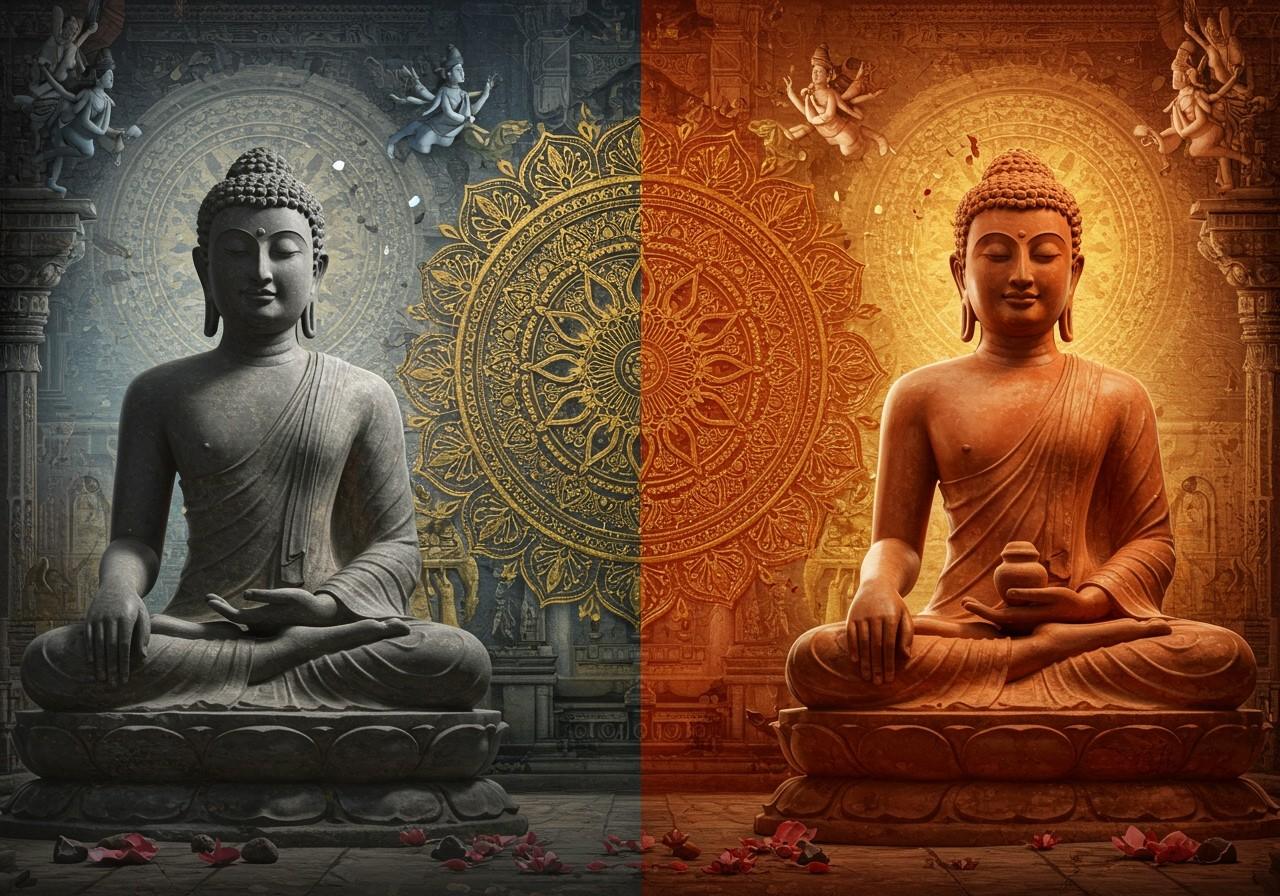
Source: Poojn.in — Gandhara vs. Mathura Art: A Comparative Study - Key ... · www.poojn.in
Early Buddhism had NO images — only Mahayana introduced image worship, not original Buddhism
Symbols ≠ Images — Early Buddhist symbols (wheel, footprints) were not idol worship like later statues
Gandhara + Mathura both created first Buddha images simultaneously in 1st-2nd century AD, not one before the other