Consider the following statements: 1. Most of the world's coral reefs are in tropical waters. 2. More than one-third of the world's coral reefs are located in the territories of Australia, Indonesia and Philippines. 3. Coral reefs host far more number of animal phyla than those hosted by tropical rainforests. Which of the statements given above is/are correct?
Contents18
- A1 and 2 only
- B3 only
- C1 and 3 only
- D1, 2 and 3
Show answer
Answer: (D) 1, 2 and 3
Correct Answer: (d) 1, 2 and 3
All three statements are correct:
Statement 1 is CORRECT: Most of the world's coral reefs are found in tropical waters. Corals need warm, shallow, clear water with sunlight to survive. They are mostly found between the Tropics of Cancer and Capricorn, in the western parts of the Indian, Pacific, and Atlantic Oceans.
Statement 2 is CORRECT: More than one-third of the world's coral reefs are in Australian waters. The Great Barrier Reef (off Australia's northeast coast) is the world's largest coral reef system and alone accounts for a huge percentage of global coral reefs. Australia has approximately 17% of the world's coral reefs.
Statement 3 is CORRECT: Australia, Indonesia, and Philippines together account for over 40% of the world's coral reefs:
- Australia: ~17%
- Indonesia: ~16%
- Philippines: ~9%
Total: ~42% — which is more than one-third.
REMEMBER: Coral reefs = tropical, warm, shallow waters. Top 3 coral reef countries = Australia (17%), Indonesia (16%), Philippines (9%). Together they have ~42% of world's reefs. Great Barrier Reef (Australia) = world's largest.
Coral reefs are among the most biodiverse ecosystems on Earth, hosting about 32 of the 33 described animal phyla compared to tropical rainforests which host only about 9-12 phyla.
The Indo-Pacific region contains about 75% of all coral reefs, with the Coral Triangle (Indonesia, Philippines, Malaysia, Papua New Guinea) being the global center of marine biodiversity.
UPSC is testing whether students understand that marine ecosystems can exceed terrestrial ecosystems in biodiversity measures, challenging the common assumption that rainforests are always the most diverse.
Global Coral Reef Distribution
Geography coral reefs tropical waters territories Australia Indonesia Philippines
Global Coral Reef Distribution: Geography & Key Locations
Most coral reefs are in tropical waters between Tropic of Cancer and Capricorn
Australia (17%), Indonesia (16%), Philippines (9%) together hold 42% of world's reefs
Great Barrier Reef (Australia) is the world's largest coral reef system
Coral reefs need warm, shallow, clear water with sunlight to survive
Geographic Requirements
Coral reefs are marine ecosystems that require very specific environmental conditions. They thrive in tropical waters because corals are living organisms that need consistent warmth, abundant sunlight for photosynthesis, and clear, shallow waters typically found between the Tropic of Cancer and Tropic of Capricorn.
Top Coral Reef Countries
Country | Percentage of World's Reefs | Key Reef Systems | Ocean Location |
|---|---|---|---|
Australia | ~17% | Great Barrier Reef, Ningaloo Reef | Pacific & Indian Ocean |
Indonesia | ~16% | Raja Ampat, Bunaken | Pacific & Indian Ocean |
Philippines | ~9% | Tubbataha, Apo Island | Pacific Ocean |
France | ~8% | New Caledonia, French Polynesia | Pacific Ocean |
Papua New Guinea | ~6% | Milne Bay, Kimbe Bay | Pacific Ocean |
Global Reef Distribution

Source: ScienceDirect.com — Coral Reef - an overview | ScienceDirect Topics · www.sciencedirect.com
Question Anchoring
Statement 1: Tropical location is correct — reefs need warm waters between 23.5°N to 23.5°S
Statement 2: Australia + Indonesia + Philippines = 42% of world's reefs (more than one-third)
The Coral Triangle (Indonesia-Philippines-Malaysia region) has the highest marine biodiversity on Earth
Trap: Confusing coral reef distribution with tropical rainforest distribution — both are tropical but reefs are marine only
Trap: Thinking temperate countries like Japan or USA have major coral reefs — they have some but not significant percentages
Trap: Assuming Brazil or African countries dominate coral reefs — the Indo-Pacific region is the global hotspot
Coral Reef Biodiversity
Environment animal phyla tropical rainforests
Coral Reef Biodiversity: Marine vs Terrestrial Ecosystems
Coral reefs host more animal phyla than tropical rainforests
Reefs cover <1% of ocean but support 25% of marine species
Tropical rainforests have higher species diversity but fewer phyla
Phylum = major taxonomic group above class (e.g. Chordata, Arthropoda)
Biodiversity Comparison
Phyla represent major body plan differences in the animal kingdom — think vertebrates (Chordata) vs insects (Arthropoda) vs jellyfish (Cnidaria). Coral reefs, despite covering less than 1% of ocean area, host representatives from more animal phyla than tropical rainforests because marine environments support more diverse body plans and evolutionary adaptations.
Reef vs Rainforest Biodiversity
Ecosystem | Animal Phyla | Species Diversity | Area Coverage | Key Feature |
|---|---|---|---|---|
Coral Reefs | More phyla | High | <1% of ocean | Diverse body plans |
Tropical Rainforests | Fewer phyla | Higher | 6% of land | High species count |
Ocean (general) | ~34 phyla | Variable | 71% of Earth | Evolutionary origin |
Land (general) | ~11-12 phyla | Variable | 29% of Earth | Limited body plans |
Why Reefs Have More Phyla
Marine origin: Most animal phyla evolved in ancient oceans before land colonization
3D habitat structure: Coral reefs provide complex vertical niches for different body plans
Stable conditions: Warm tropical waters maintain consistent environment for diverse groups
Filter feeding opportunities: Many marine phyla (sponges, corals, bivalves) use water-column feeding
Trap: Confusing species diversity (rainforests win) with phyla diversity (reefs win)
Trap: Thinking terrestrial ecosystems must have more phyla because they seem more diverse
Trap: Assuming area size correlates with phyla diversity — reefs are tiny but phyla-rich
Great Barrier Reef System
Geography Australia Great Barrier Reef
Great Barrier Reef: World's Largest Coral System
Great Barrier Reef is the world's largest coral reef system
Located off Australia's northeast coast (Queensland)
UNESCO World Heritage Site since 1981
Faces threats from coral bleaching and climate change
Geographic Extent
The Great Barrier Reef stretches over 2,300 kilometers along Australia's northeast coast in the Coral Sea. It consists of approximately 2,900 individual reefs and 900 islands, making it visible from space and earning recognition as both a UNESCO World Heritage Site and one of the Seven Natural Wonders of the World.
Great Barrier Reef Location
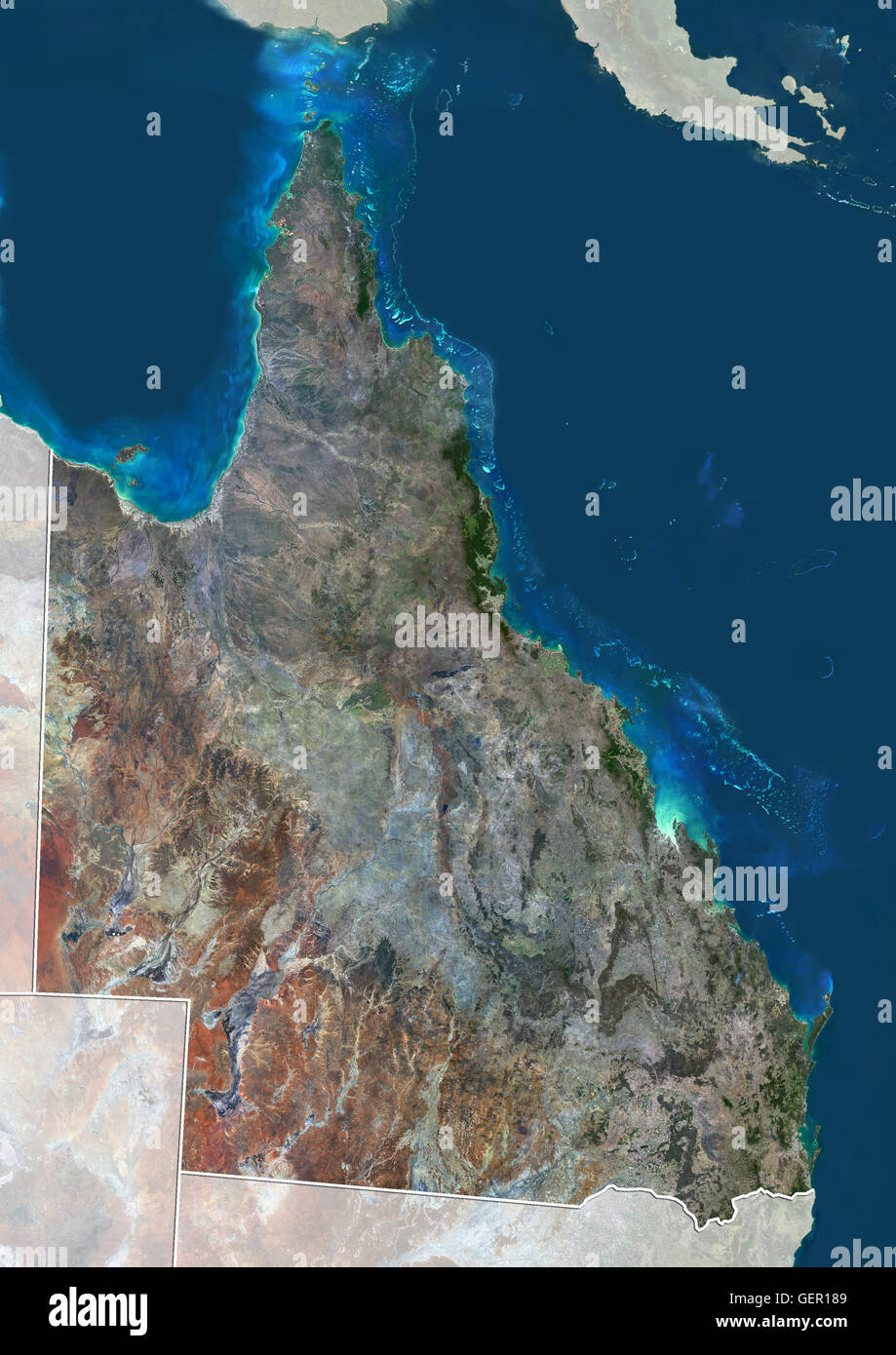
Source: Alamy — Satellite view of Queensland, Australia (with administrative boundaries and mask). The Great Barrier Reef extends along · www.alamy.com
Key Facts & Threats
Size: Covers approximately 344,000 sq km — larger than the United Kingdom
Biodiversity: Home to 1,500+ fish species, 400+ coral species, and 4,000+ mollusk species
Economic value: Generates $6+ billion annually from tourism and fishing
Climate threat: Experienced major coral bleaching events in 2016, 2017, and 2020
Protection: Managed by Great Barrier Reef Marine Park Authority (GBRMPA)
Trap: Confusing Great Barrier Reef with other Australian reefs like Ningaloo Reef (Western Australia)
Trap: Thinking the reef is on Australia's west coast — it's on the northeast coast (Pacific side)
Trap: Assuming all of Australia's 17% reef share is just the Great Barrier Reef — Australia has multiple reef systems
Coral Triangle Region
Geography Indonesia Philippines
Coral Triangle: Global Center of Marine Biodiversity
Coral Triangle spans Indonesia, Malaysia, Philippines, Papua New Guinea, Timor-Leste, Solomon Islands
Contains 76% of all coral species and highest marine biodiversity on Earth
Covers 5.7 million sq km of ocean in the Indo-Pacific region
Often called Amazon of the Seas due to biodiversity richness
Biodiversity Epicenter
The Coral Triangle is the global epicenter of marine biodiversity, containing the richest coral reef ecosystems on Earth. This region in the Indo-Pacific supports over 120 million people who depend on its marine resources for food security and livelihoods.
Coral Triangle Countries
# Coral Triangle
## **Indonesia**
- 16% of world's reefs
- Raja Ampat region
- Bunaken National Park
- Wakatobi reefs
## **Philippines**
- 9% of world's reefs
- Tubbataha Reefs
- Apo Island
- Palawan reefs
## **Malaysia**
- Sipadan Island
- Mabul Island
- Redang Island
- Sabah reefs
## **Papua New Guinea**
- Milne Bay
- Kimbe Bay
- Rabaul reefs
- Bismarck Sea
Coral Triangle Map

Source: UPSC Colorfull notes — The Coral Triangle: A Marine Biodiversity Hotspot in Crisis [MAP ... · upsccolorfullnotes.com
Conservation Significance
Species richness: 600+ coral species (76% of world total), 2,000+ reef fish species
Economic importance: Supports $3+ billion annual fisheries and tourism industry
Food security: Provides protein for 120+ million people in the region
Climate resilience: Contains reefs that may be more heat-tolerant and survive warming
Threats: Overfishing, coastal development, pollution, and climate change