La Nina is suspected to have caused recent floods in Australia. How is La Nina different from El Nino? 1. La Nina is characterised by unusually cold ocean temperature in equatorial Indian Ocean whereas El Nino is characterised by unusually warm ocean temperature in the equatorial Pacific Ocean. 2. El Nino has adverse effect on south-west monsoon of India, but La Nina has no effect on monsoon climate. Which of the statements given above is/are correct?
Contents13
- A1 only
- B2 only
- CBoth 1 and 2
- DNeither 1 nor 2
Show answer
Answer: (D) Neither 1 nor 2
Both statements are WRONG.
Statement 1 error:
La Niña is characterized by unusually COLD water in the equatorial PACIFIC Ocean (not Indian Ocean).
Both El Niño and La Niña are Pacific Ocean phenomena.
El Niño = unusually WARM Pacific waters;
La Niña = unusually COLD Pacific waters.
They are opposite phases of the same cycle (ENSO).
Statement 2 error:
La Niña DOES affect the Indian monsoon — it generally STRENGTHENS it (brings more rainfall to India), which is the opposite of El Niño's effect (weakens monsoon, causes drought).
Easy way to remember:
El Niño = warm Pacific = BAD for Indian monsoon.
La Niña = cold Pacific = GOOD for Indian monsoon (more rain, but can cause floods).
La Niña and El Niño are opposite phases of the same Pacific Ocean cycle that directly affect India's monsoon rainfall patterns.
The 2010-11 La Niña event caused severe flooding in Australia and affected global weather patterns, making it a relevant current topic for the 2011 exam.
UPSC is testing whether students can distinguish between Pacific Ocean phenomena (El Niño/La Niña) versus Indian Ocean phenomena, and understand that La Niña strengthens rather than weakens the Indian monsoon.
El Niño Phenomenon
Geography El Nino unusually warm ocean temperature equatorial Pacific Ocean
El Niño: Warm Pacific Waters & Monsoon Impact
El Niño = unusually warm waters in equatorial Pacific Ocean
Weakens Indian southwest monsoon, causes droughts
Part of ENSO cycle (El Niño Southern Oscillation)
Occurs every 2-7 years, lasts 9-12 months
El Niño means 'little boy' in Spanish. It's a climate pattern where ocean waters in the central and eastern Pacific become unusually warm, disrupting normal weather patterns globally.
How El Niño Works
%%{init: {"flowchart": {"wrappingWidth": 460}}}%%
flowchart TD
  s1["`**Normal Conditions**
Trade winds blow warm water westward; cold water rises in eastern Pacific`"]
  s2["`**El Niño Onset**
Trade winds weaken or reverse; warm water spreads eastward`"]
  s3["`**Peak Phase**
Sea surface temperatures rise **2-3°C** above normal in equatorial Pacific`"]
  s4["`**Global Impact**
Disrupts weather patterns worldwide, including Indian monsoon`"]
  s1 --> s2
  s2 --> s3
  s3 --> s4
El Niño Impact on India
Weakens southwest monsoon rainfall by disrupting atmospheric circulation
Causes drought conditions in India, especially in northwestern regions
Leads to delayed monsoon onset and early withdrawal
Associated with higher temperatures during summer months
Can trigger food security concerns due to poor agricultural yields
Trap: Don't confuse with Indian Ocean - both El Niño and La Niña occur in Pacific Ocean
Trap: El Niño weakens Indian monsoon (causes drought), not strengthens it
Trap: El Niño brings warm water, La Niña brings cold water - opposite effects
La Niña Phenomenon
Geography La Nina cold ocean temperature
La Niña: Cold Pacific Waters & Enhanced Monsoon
La Niña = unusually cold waters in equatorial Pacific Ocean
Strengthens Indian southwest monsoon, can cause floods
Opposite phase of El Niño in the ENSO cycle
Lasts 1-3 years, longer than El Niño
La Niña means 'little girl' in Spanish. It represents the cold phase of ENSO when Pacific waters become cooler than normal, often following an El Niño event.
El Niño vs La Niña Comparison
Aspect | El Niño | La Niña |
|---|---|---|
Pacific Water Temperature | Unusually warm (+2-3°C) | Unusually cold (-1-2°C) |
Trade Winds | Weaken or reverse | Strengthen |
Indian Monsoon Effect | Weakens (drought) | Strengthens (excess rain) |
Frequency | Every 2-7 years | Every 2-7 years |
Duration | 9-12 months | 1-3 years |
India Impact | Drought, heat | Floods, cooler temps |
La Niña Impact on India
Enhances southwest monsoon, brings above-normal rainfall
Can cause flooding in monsoon-dependent regions
Associated with cooler summers and active monsoon systems
Beneficial for agriculture but can cause waterlogging
Often leads to cyclone activity in Bay of Bengal
Trap: La Niña DOES affect Indian monsoon - it strengthens it, causing floods
Trap: Both phenomena occur in Pacific Ocean, not Indian Ocean
Trap: La Niña = cold Pacific water, El Niño = warm Pacific water
ENSO Cycle
Geography
ENSO: The Complete El Niño Southern Oscillation Cycle
ENSO = El Niño Southern Oscillation, complete climate cycle
Has 3 phases: El Niño (warm), La Niña (cold), Neutral
Affects global weather patterns through teleconnections
Monitored using SOI (Southern Oscillation Index)
ENSO is the complete climate cycle in the Pacific Ocean that includes both El Niño and La Niña as opposite phases. It's the strongest year-to-year climate signal on Earth.
ENSO Three Phases
# ENSO Cycle
## El Niño Phase
- Warm Pacific waters
- Weak trade winds
- Dry conditions in Australia
- Droughts in India
## Neutral Phase
- Normal Pacific temperatures
- Regular trade winds
- Typical monsoon patterns
- Baseline climate conditions
## La Niña Phase
- Cold Pacific waters
- Strong trade winds
- Floods in Australia
- Enhanced Indian monsoon
ENSO Visual Pattern
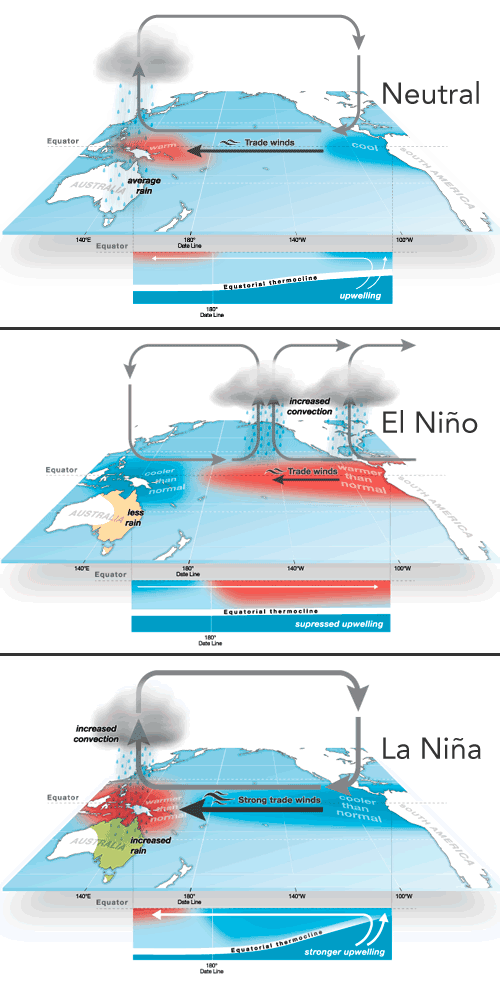
Source: Drishti IAS — El Nino and La Nina · www.drishtiias.com
Global ENSO Impacts
Australia: El Niño brings drought, La Niña brings floods (as mentioned in the question)
India: El Niño weakens monsoon, La Niña strengthens it
Americas: El Niño brings heavy rains to Peru/Ecuador, dry conditions to Brazil
Africa: El Niño can cause droughts in eastern Africa
Teleconnections: ENSO affects weather patterns across continents through atmospheric linkages
Monsoon-ENSO Relationship
Geography south-west monsoon monsoon climate
How ENSO Controls Indian Monsoon Strength
El Niño years: Weak monsoon, drought risk in India
La Niña years: Strong monsoon, flood risk in India
Walker Circulation links Pacific conditions to Indian rainfall
Not 100% correlation - other factors like IOD also matter
The Indian monsoon is closely linked to Pacific Ocean conditions through atmospheric teleconnections. ENSO events can make or break India's agricultural season.
El Niño → Weak Monsoon Mechanism
%%{init: {"flowchart": {"wrappingWidth": 460}}}%%
flowchart TD
  s1["`**El Niño Develops**
Warm waters in central/eastern Pacific`"]
  s2["`**Walker Circulation Weakens**
Reduced pressure gradient across Pacific`"]
  s3["`**Monsoon Circulation Disrupted**
Weaker low pressure over India`"]
  s4["`**Reduced Rainfall**
Southwest monsoon brings less moisture to India`"]
  s1 --> s2
  s2 --> s3
  s3 --> s4
Historical ENSO-Monsoon Examples
ENSO Phase | Typical Monsoon Impact | Agricultural Effect | Economic Impact |
|---|---|---|---|
Strong El Niño | 50-60% below normal rainfall | Crop failure, water stress | GDP growth slows, inflation rises |
Moderate El Niño | 20-30% below normal rainfall | Reduced yields, irrigation stress | Agricultural output declines |
La Niña | 10-20% above normal rainfall | Good yields, but waterlogging risk | Rural income rises, flood damage |
Neutral ENSO | Normal to slightly above rainfall | Stable agricultural production | Balanced economic conditions |
Trap: Both El Niño and La Niña affect Indian monsoon - La Niña is NOT neutral
Trap: La Niña strengthens monsoon (can cause floods), doesn't weaken it
Trap: The 2010-2012 La Niña caused Australia floods (mentioned in question) AND strong Indian monsoons