Consider the following statements: Statement-I: The temperature contrast between continents and oceans is greater during summer than in winter. Statement-II: The specific heat of water is more than that of land surface. Which one of the following is correct in respect of the above statements?
Contents15
- ABoth Statement-I and Statement-II are correct and Statement-II is the correct explanation for Statement-I
- BBoth Statement-I and Statement-II are correct and Statement-II is not the correct explanation for Statement-I
- CStatement-I is correct but Statement-II is incorrect
- DStatement-I is incorrect but Statement-II is correct
Show answer
Answer: (D) Statement-I is incorrect but Statement-II is correct
Statement I is incorrect:
The temperature contrast between continents and oceans is actually greater during winter than during summer.
Reason:
- Land heats up and cools down much faster than water.
- During winter, continents lose heat rapidly and become much colder, while oceans retain heat for a longer time.
- This creates a much sharper land-sea temperature contrast in winter.
Therefore, Statement I is incorrect.
Statement II is correct:
Water has a higher specific heat than land.
This means:
- water requires more heat energy to change its temperature,
- so oceans heat up and cool down more slowly than continents.
This property explains why oceans moderate temperature changes compared to land.
Therefore:
- Statement I is incorrect.
- Statement II is correct.
Hence, the correct answer is:
Statement-I is incorrect but Statement-II is correct.
Water's high specific heat capacity creates the temperature contrasts that drive monsoons, sea breezes, and other wind systems that affect billions of people.
The question tests whether students can connect a basic physics concept (specific heat) to explain real-world climate patterns like land-sea temperature differences.
Specific Heat Capacity of Water vs Land
Geography specific heat water land surface
Specific Heat Capacity: Why Water & Land Heat Differently
Water has higher specific heat capacity than land - takes more energy to heat up
Land heats up quickly in summer, cools down quickly in winter
Oceans heat up slowly in summer, cool down slowly in winter
This creates maximum temperature contrast in summer, minimum in winter
Core Concept
Specific heat capacity is the amount of energy needed to raise the temperature of 1 gram of a substance by 1°C. Water requires much more energy than land to change temperature - this fundamental difference drives global climate patterns and seasonal temperature contrasts.
Water vs Land Properties
Property | Water | Land | Climate Impact |
|---|---|---|---|
Specific Heat Capacity | 4.18 J/g°C (high) | 0.8 J/g°C (low) | Water resists temperature change |
Summer Heating | Heats up slowly | Heats up rapidly | Maximum contrast in summer |
Winter Cooling | Cools down slowly | Cools down rapidly | Minimum contrast in winter |
Temperature Range | Moderate annual range | Extreme annual range | Continental vs oceanic climates |
How Seasonal Contrast Develops
%%{init: {"flowchart": {"wrappingWidth": 460}}}%%
flowchart TD
  s1["`**Summer Arrives**
Solar radiation increases globally`"]
  s2["`**Land Response**
**Low specific heat** → land surfaces heat up rapidly → high temperatures`"]
  s3["`**Ocean Response**
**High specific heat** → water bodies heat up slowly → moderate temperatures`"]
  s4["`**Maximum Contrast**
**Greatest temperature difference** between continents and oceans in summer`"]
  s5["`**Winter Pattern**
Land cools rapidly, oceans retain heat → **smaller contrast** in winter`"]
  s1 --> s2
  s2 --> s3
  s3 --> s4
  s4 --> s5
Question Connection
This PYQ tests the causal relationship between thermal properties and seasonal patterns. Statement-II (specific heat difference) directly explains Statement-I (greater summer contrast) - making option A correct.
Trap: Thinking temperature contrast is greater in winter - actually maximum in summer
Trap: Confusing specific heat with heat capacity - specific heat is per unit mass
Trap: Missing the causal link between statements - II explains I, not just both being true
Trap: Reversing the heating rates - water heats slowly, land heats quickly
Continental vs Oceanic Temperature Patterns
Geography temperature contrast continents oceans summer winter
Continental vs Oceanic Temperature Patterns & Seasonal Contrasts
Summer: Maximum temperature contrast between land and sea
Winter: Minimum temperature contrast between land and sea
Continental interiors have extreme temperature ranges
Coastal areas have moderate temperature ranges due to oceanic influence
Seasonal Pattern
The temperature difference between continents and oceans follows a clear seasonal cycle. Summer creates the maximum contrast as land heats rapidly while oceans remain cooler. Winter creates minimum contrast as land cools rapidly while oceans retain warmth.
Seasonal Temperature Contrasts
Season | Land Temperature | Ocean Temperature | Contrast Level | Climate Effect |
|---|---|---|---|---|
Summer | Very Hot | Moderately Warm | MAXIMUM | Strong land-sea pressure gradients |
Winter | Very Cold | Moderately Cool | MINIMUM | Weak land-sea pressure gradients |
Spring | Warming Fast | Warming Slowly | Increasing | Transitional weather patterns |
Autumn | Cooling Fast | Cooling Slowly | Decreasing | Transitional weather patterns |
Climate Type Classification
# Land-Sea Temperature Effects
## Continental Climate
- Extreme temperature range
- Hot summers
- Cold winters
- Low humidity
- Interior locations
## Oceanic/Maritime Climate
- Moderate temperature range
- Cool summers
- Mild winters
- High humidity
- Coastal locations
## Monsoon Effects
- Summer low pressure over land
- Winter high pressure over land
- Seasonal wind reversal
- Precipitation patterns
Global Temperature Patterns
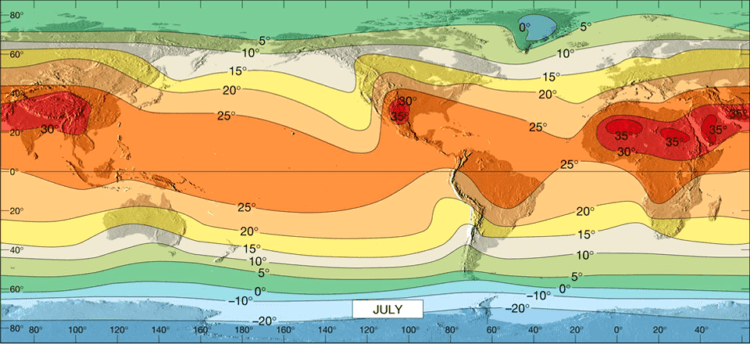
Source: ClearIAS — Distribution of Temperature in the Earth's Atmosphere ... · www.clearias.com
Trap: Thinking winter has maximum contrast - it's actually summer
Trap: Confusing continental climate with just 'climate of continents'
Trap: Missing that this principle drives monsoon systems globally
Trap: Forgetting that coastal areas have oceanic influence even on continents
Statement-Explanation Question Format in UPSC
Geography
UPSC Statement-Explanation Questions: How to Solve
Check if both statements are factually correct first
Then check if Statement-II explains Statement-I causally
Option A: Both correct + II explains I
Option B: Both correct + II does NOT explain I
Question Strategy
UPSC frequently tests causal relationships through Statement-Explanation format. The key is checking not just factual accuracy, but whether Statement-II provides the scientific reason for Statement-I.
Solution Method
%%{init: {"flowchart": {"wrappingWidth": 460}}}%%
flowchart TD
  s1["`**Step 1**
Is Statement-I factually correct? (Yes/No)`"]
  s2["`**Step 2**
Is Statement-II factually correct? (Yes/No)`"]
  s3["`**Step 3**
Does Statement-II **explain the cause** of Statement-I?`"]
  s4["`**Decision**
If both true + II explains I → **Option A**. If both true + II doesn't explain I → **Option B**`"]
  s1 --> s2
  s2 --> s3
  s3 --> s4
Option Elimination Guide
Option | Statement-I | Statement-II | Explanation Link | When to Choose |
|---|---|---|---|---|
A | Correct | Correct | II explains I | Both true AND causal link exists |
B | Correct | Correct | II does NOT explain I | Both true BUT no causal link |
C | Correct | Incorrect | N/A | Only Statement-I is factually correct |
D | Incorrect | Correct | N/A | Only Statement-II is factually correct |
This Question Analysis
Statement-I (greater summer contrast) is correct. Statement-II (water's higher specific heat) is correct. Crucially, II explains why I happens - water's thermal properties cause the seasonal contrast pattern. Hence Option A.
Trap: Choosing Option B when clear causal relationship exists
Trap: Not checking factual accuracy of each statement independently first
Trap: Confusing correlation with causation in explanation links
Trap: Overthinking the direction of causation - II should explain I, not vice versa