Consider the following protected areas: 1. Bandipur 2. Bhitarkanika 3. Manas 4. Sunderbans Which of the above are declared Tiger Reserves?
Contents13
- A1 and 2 only
- B1, 3 and 4 only
- C2, 3 and 4 only
- D1, 2, 3 and 4
Show answer
Answer: (B) 1, 3 and 4 only
Among the listed protected areas:
Bandipur (Karnataka) — declared Tiger Reserve in 1973 (one of the first under Project Tiger).
Manas (Assam) — Tiger Reserve and UNESCO World Heritage Site.
Sunderbans (West Bengal) — Tiger Reserve, famous for Royal Bengal Tigers in mangrove forests.
Bhitarkanika (Odisha) — is a National Park and Wildlife Sanctuary known for saltwater crocodiles and mangroves, but it is NOT a Tiger Reserve. It is more associated with crocodile conservation.
Answer: 1, 3 and 4 only (Bandipur, Manas, Sunderbans).
India has 53 Tiger Reserves under Project Tiger, which began in 1973 with 9 original reserves including Bandipur and Manas.
Bhitarkanika is specifically known for saltwater crocodile conservation, not tigers, despite being in similar coastal mangrove habitat as the Sunderbans Tiger Reserve.
The question tests whether students can distinguish between different types of protected area designations and their specific conservation focuses.
Project Tiger & Tiger Reserves
Environment Tiger Reserves Bandipur Manas Sunderbans
Project Tiger & Tiger Reserves: UPSC Key Facts
Project Tiger launched in 1973 with 9 initial reserves including Bandipur
Bandipur, Manas, and Sunderbans are Tiger Reserves; Bhitarkanika is not
India has 53 Tiger Reserves covering 75,000+ sq km
NTCA (National Tiger Conservation Authority) manages Tiger Reserves under Wildlife Protection Act 1972
Project Tiger Genesis
Project Tiger was launched in 1973 as India's flagship species conservation program after tiger population dropped to around 1,800. It established the first 9 Tiger Reserves with Bandipur among the pioneers.
Question Areas Analysis
Protected Area | State | Tiger Reserve Status | Key Feature |
|---|---|---|---|
Bandipur | Karnataka | ✓ Yes (1973) | Original Project Tiger reserve |
Manas | Assam | ✓ Yes | UNESCO World Heritage Site |
Sunderbans | West Bengal | ✓ Yes | Mangrove tigers, largest delta |
Bhitarkanika | Odisha | ✗ No | Saltwater crocodile sanctuary |
Tiger Reserve Structure
Core Area: Inviolate zone with minimal human interference, legal status of National Park/Sanctuary
Buffer Zone: Surrounds core area, allows regulated activities and eco-development
Tiger Conservation Foundation: Manages each reserve with state government participation
Monitoring: Annual tiger census using camera traps and pugmark analysis
Funding: Central government provides 60% funding, states contribute 40%
Tiger Reserves Distribution

Source: MapsforUPSC — Tiger Reserves in India: Map, Key Facts & State-wise List 2026 · mapsforupsc.com
Bhitarkanika is famous for saltwater crocodiles, not tigers — classic UPSC confusion
Don't confuse Bandipur (Karnataka Tiger Reserve) with Bandipore (J&K town)
Manas is both Tiger Reserve AND UNESCO World Heritage Site — dual status often tested
Sunderbans tigers are unique for swimming and mangrove adaptation — not typical forest tigers
Bhitarkanika National Park
Environment Bhitarkanika
Bhitarkanika: Crocodile Sanctuary & Mangrove Haven
Bhitarkanika is in Odisha, famous for saltwater crocodiles — NOT tigers
India's largest saltwater crocodile population with 1,700+ individuals
Second-largest mangrove ecosystem in India after Sunderbans
Why Not Tiger Reserve
Bhitarkanika is a mangrove ecosystem in Odisha's Kendrapara district. Its wetland habitat supports saltwater crocodiles, not tigers. The area became famous for crocodile breeding programs and turtle nesting sites.
Bhitarkanika Key Features
Aspect | Details |
|---|---|
Location | Kendrapara district, Odisha |
Ecosystem | Mangrove forests and tidal wetlands |
Star Species | Saltwater crocodiles (Crocodylus porosus) |
Status | National Park + Wildlife Sanctuary |
Area | 672 sq km including core and buffer |
Rivers | Brahmani, Baitarani, Dhamra confluence |
Other Wildlife | Olive Ridley turtles, water monitor lizards |
Conservation Significance
Crocodile Breeding Program: Successful conservation increased population from near-extinction
Olive Ridley Nesting: Gahirmatha Beach within sanctuary hosts mass nesting
Mangrove Diversity: 62 mangrove species provide coastal protection
Fishing Cat Habitat: Rare wild cat species thrives in wetland environment
Bhitarkanika = Crocodiles, Sunderbans = Tigers — both are mangrove areas but different flagship species
Don't confuse Bhitarkanika (Odisha) with Bhiterkanika — spelling variation sometimes used
Gahirmatha is within Bhitarkanika for turtle nesting — not a separate sanctuary
Mangrove Protected Areas
Environment Sunderbans Bhitarkanika
India's Major Mangrove Protected Areas: Comparison
Sunderbans (West Bengal) — largest mangrove forest, Tiger Reserve + World Heritage Site
Bhitarkanika (Odisha) — second-largest mangroves, saltwater crocodile sanctuary
Both are UNESCO Biosphere Reserves but only Sunderbans has tigers
Major Mangrove Sanctuaries
Protected Area | State | Flagship Species | UNESCO Status | Key Rivers |
|---|---|---|---|---|
Sunderbans | West Bengal | Royal Bengal Tiger | World Heritage Site | Ganga delta |
Bhitarkanika | Odisha | Saltwater Crocodile | Biosphere Reserve | Brahmani, Baitarani |
Gulf of Mannar | Tamil Nadu | Dugong | Biosphere Reserve | Palk Strait |
Pichavaram | Tamil Nadu | Mangrove diversity | Not designated | Vellar, Coleroon |
Mangrove Adaptation Features
Pneumatophores: Aerial roots for oxygen in waterlogged soil
Salt Excretion: Special glands remove excess salt from seawater
Viviparous Seeds: Seeds germinate while attached to parent tree
Tidal Tolerance: Survive twice-daily flooding and exposure cycles
Mangrove Distribution
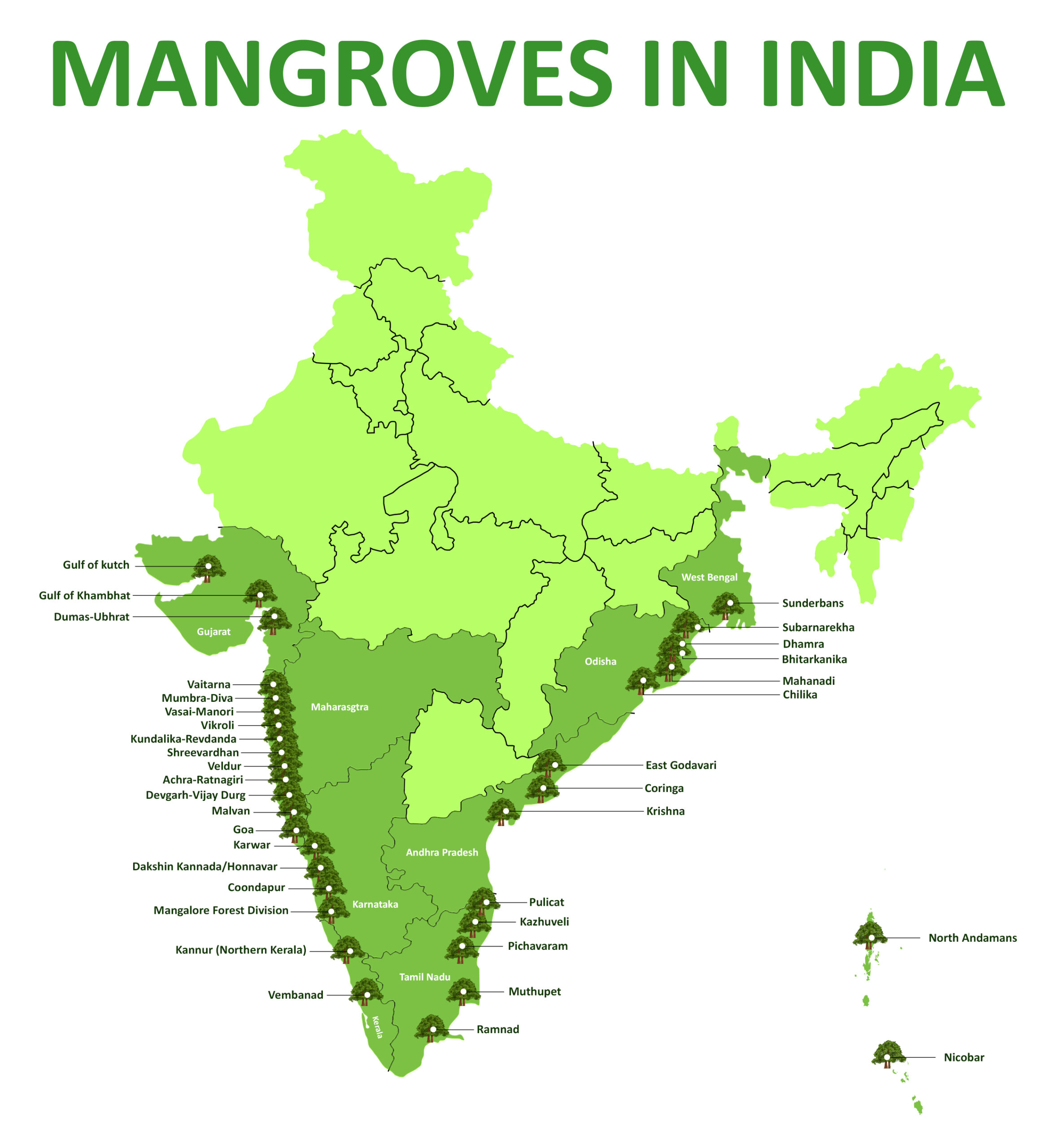
Source: StudyIQ — Mangrove Forest in India 2026: Latest Data, Maps, States and ... · www.studyiq.com
Both Sunderbans and Bhitarkanika are mangroves — but only Sunderbans has tigers
Royal Bengal Tiger in Sunderbans can swim — unique adaptation for mangrove hunting
Don't assume all coastal sanctuaries are Tiger Reserves — habitat matters more than location