With reference to India's Desert National Park, which of the following statements are correct? 1. It is spread over two districts. 2. There is no human habitation inside the Park. 3. It is one of the natural habitats of Great Indian Bustard. Select the correct answer using the code given below:
Contents16
- A1 and 2 only
- B2 and 3 only
- C1 and 3 only
- D1, 2 and 3
Show answer
Answer: (C) 1 and 3 only
Desert National Park is located in western Rajasthan, near Jaisalmer and Barmer.
Statement 1 (Spread over two districts) — CORRECT: The park covers 3,162 km², spread over Jaisalmer district (1,900 km²) and Barmer district (1,262 km²).
Statement 2 (No human habitation inside) — NOT CORRECT: This is the tricky part. The Thar Desert is the most densely populated desert in the world (83 persons/km²). While the population density inside the park is low (4-5 persons/km²), there ARE 73 villages and settlements (called "Dhanis") inside the park. These communities have lived there for hundreds of years.
Statement 3 (Natural habitat of Great Indian Bustard) — CORRECT: The Desert National Park is the most important site for the long-term survival of the globally threatened Great Indian Bustard. Other significant birds found here include the Houbara Bustard, endangered vultures, and 11 species from Biome-13.
Answer: C (1 and 3 only).
Key Takeaway: Desert National Park = 2 districts (Jaisalmer + Barmer) + HAS human habitation (73 villages) + Great Indian Bustard's most important habitat.
Desert National Park in Rajasthan is the most important habitat for the critically endangered Great Indian Bustard, with fewer than 200 birds remaining in the wild.
Unlike typical national parks, Desert National Park contains 73 villages with around 4-5 people per square kilometer, making it unique among India's protected areas.
UPSC is testing whether students know that some national parks allow human habitation, challenging the common assumption that all national parks are completely uninhabited.
Desert National Park, Rajasthan
Environment Desert National Park Jaisalmer Barmer
Desert National Park: Location, Features & UPSC Facts
Located in Jaisalmer and Barmer districts of Rajasthan
Contains 73 villages inside the park - human habitation exists
Most important habitat for Great Indian Bustard
Area: 3,162 km² - one of India's largest national parks
Key Features
Desert National Park is India's largest national park, covering 3,162 km² in western Rajasthan. Unlike many protected areas, it maintains a unique balance between conservation and traditional desert communities who have lived there for centuries.
Park Distribution
District | Area (km²) | Key Features |
|---|---|---|
Jaisalmer | 1,900 | Larger portion, near Pakistan border |
Barmer | 1,262 | Smaller portion, more settlements |
Wildlife Significance
Great Indian Bustard: Most critical habitat for this Critically Endangered species
Houbara Bustard: Another endangered bustard species found here
Desert ecosystem: Represents unique Thar Desert biodiversity
11 species from Biome-13: Important for desert-adapted bird species
Geographic Location

Source: Naparks — Desert National Park » Naparks · naparks.com
Trap: Statement 2 claims 'no human habitation' - FALSE. Desert NP has 73 villages inside
Common confusion: Thar Desert is the most densely populated desert globally (83 persons/km²)
Don't mix up: Desert NP vs other Rajasthan parks like Ranthambore or Sariska
Remember: Great Indian Bustard's most important site, not just 'one of the habitats'
Great Indian Bustard
Environment Great Indian Bustard
Great Indian Bustard: Conservation Status & Habitat
Critically Endangered - fewer than 200 birds left in wild
Desert National Park is most important habitat
Threatened by power lines and habitat loss
State bird of Rajasthan
Conservation Crisis
The Great Indian Bustard is one of India's most endangered birds, with population declining from thousands to fewer than 200 individuals. Desert National Park holds the largest remaining population and represents the species' last stronghold.
Current Distribution
State | Population | Key Sites |
|---|---|---|
Rajasthan | ~150 birds | Desert National Park, Pokhran |
Gujarat | ~30 birds | Kutch region |
Maharashtra | ~10 birds | Ahmednagar, Solapur |
Karnataka | ~5 birds | Bellary district |
Major Threats
Power line collisions: Primary cause of death due to poor eyesight
Habitat conversion: Grasslands converted to agriculture
Hunting pressure: Historical hunting reduced populations
Renewable energy projects: Solar/wind farms in habitat areas
Don't confuse: Great Indian Bustard vs Lesser Florican (different species)
Status confusion: It's Critically Endangered, not just Endangered
Habitat mistake: Primarily grassland bird, not forest species
Human Habitation in Protected Areas
Environment human habitation villages
Human Settlements in India's Protected Areas
Many Indian protected areas contain traditional settlements
Relocation is complex and often incomplete
Desert NP has 73 villages - classic UPSC trap question
Reality vs Expectation
UPSC often tests the misconception that protected areas are completely uninhabited. In reality, many national parks and sanctuaries in India contain villages that existed before the area was designated for protection.
Examples of Human Habitation
Protected Area | Human Presence | Management Approach |
|---|---|---|
Desert National Park | 73 villages/dhanis | Coexistence with traditional communities |
Ranthambore NP | Several villages | Ongoing relocation efforts |
Kanha NP | Buffer zone settlements | Eco-development programs |
Bandipur NP | Relocated most villages | Some settlements remain in buffer |
Management Challenges
Legal complexity: Rights of traditional communities vs conservation needs
Voluntary relocation: Requires consent and adequate compensation
Buffer zones: Often contain more settlements than core areas
Livelihood concerns: Communities depend on forest resources
Classic trap: 'No human habitation' statements are often FALSE for Indian PAs
Don't assume: Even famous national parks may have internal settlements
Thar Desert specificity: Most densely populated desert globally - habitation is normal
Major Protected Areas of Rajasthan
Environment
Rajasthan's Key Protected Areas & Their Specialties
Desert National Park - largest, Great Indian Bustard habitat
Ranthambore - famous tiger reserve with historic fort
Keoladeo Ghana - UNESCO World Heritage bird sanctuary
Major Protected Areas Comparison
Protected Area | Type | Key Species | Unique Feature |
|---|---|---|---|
Desert National Park | National Park | Great Indian Bustard | Largest park, 2 districts |
Ranthambore | Tiger Reserve | Bengal Tiger | Historic Ranthambore Fort |
Keoladeo Ghana | National Park | Migratory birds | UNESCO World Heritage Site |
Sariska | Tiger Reserve | Bengal Tiger | Kankwari Fort, reintroduced tigers |
Mount Abu | Wildlife Sanctuary | Sloth bear | Hill station ecosystem |
Rajasthan Protected Areas
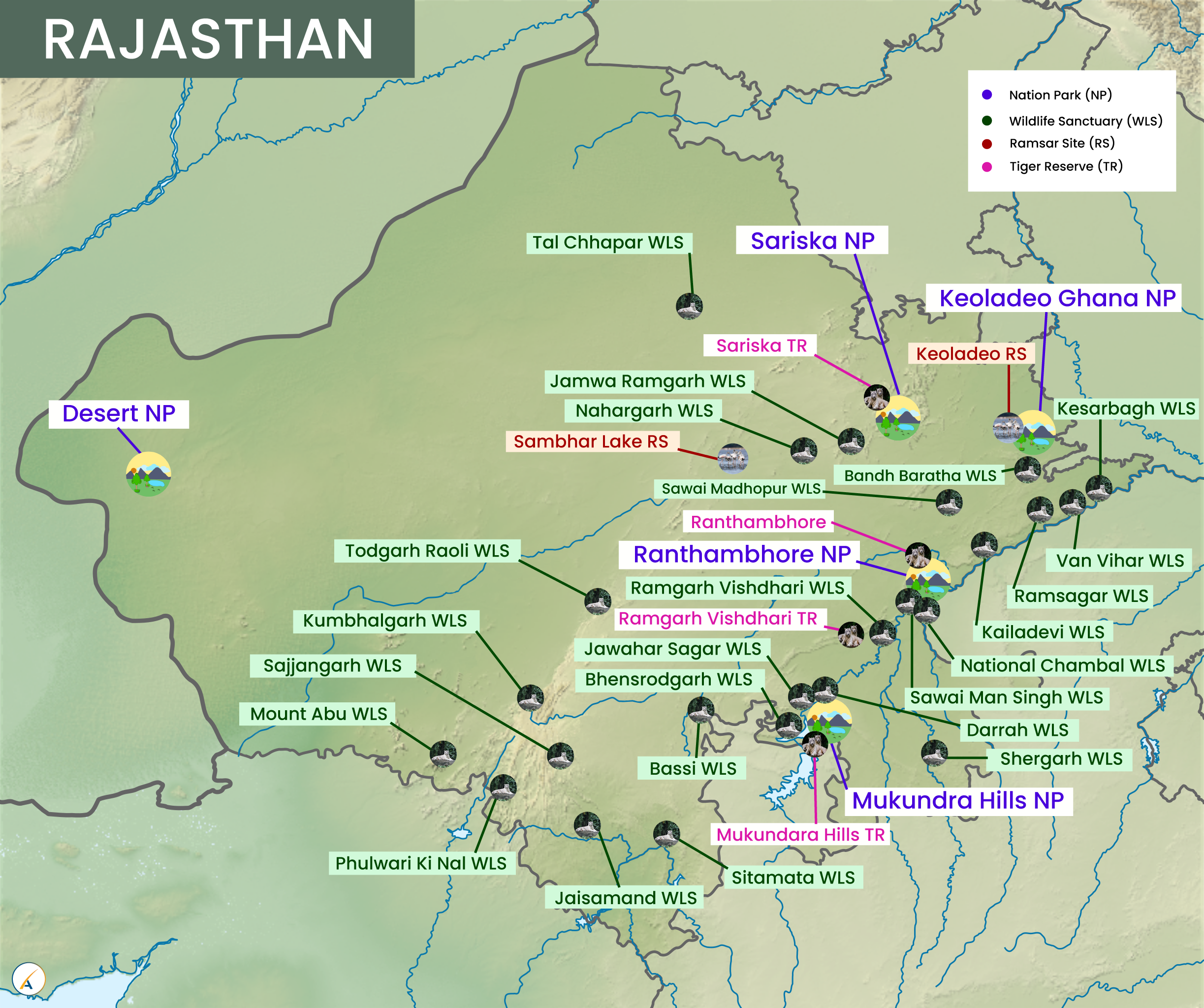
Source: LotusArise — Rajasthan National Parks, Tiger Reserves, Wildlife Sanctuaries ... · lotusarise.com
Size confusion: Desert NP is largest by area, not Ranthambore
UNESCO status: Only Keoladeo Ghana is World Heritage Site in Rajasthan
Tiger reserves: Ranthambore and Sariska both have tigers, but different histories